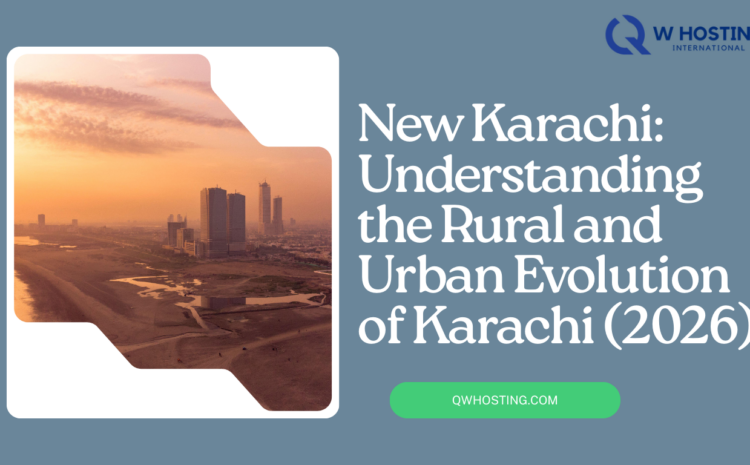
New Karachi: Understanding the Rural and Urban Evolution of Karachi (2026)

The city of Karachi is the biggest city in Pakistan and the most complicated in South Asia. Karachi has grown through the decades to become a large metropolitan region that has integrated planned communities such as New Karachi to what was known as the Old Karachi. Through the way New Karachi and Old Karachi intersect, as with rural and urban aspects, the readers are able to perceive the way the city keeps growing in 2026. This guide explores the historical developments of Karachi, its demographics, oscillations in the economy and the infrastructure construction that characterizes the city of today.
Karachi: Pakistan’s Largest Urban Center
Karachi serves as Pakistan’s financial and industrial hub. With over 20 million residents, it contributes nearly 25% of Pakistan’s GDP and handles about 90% of the country’s international trade through its ports.
The city’s growth has created distinct zones:
- Old Karachi – the historic urban core
- New Karachi – planned residential and industrial areas
- Rural Karachi – peripheral settlements and agricultural zones
These layers together shape Karachi’s complex urban structure.
Old Karachi: The Historical Foundation of the City
Old Karachi refers to the historic districts that formed the original city before massive urban expansion.
Key Characteristics of Old Karachi
- Historic neighborhoods
- Colonial-era infrastructure
- Dense population
- Traditional markets and trade centers
Areas such as Saddar, Lyari, and Kharadar represent the cultural roots of Karachi.
Economic Role
Old Karachi remains the heart of small businesses, wholesale markets, and trade. Markets such as Bolton Market and Jodia Bazaar continue to drive commercial activity.
Challenges in Old Karachi
Despite its economic significance, Old Karachi faces several issues:
- Aging infrastructure
- High population density
- Limited urban planning
- Traffic congestion
These challenges encouraged the development of planned settlements like New Karachi.
New Karachi: Planned Urban Expansion
New Karachi was developed as part of a government urban planning initiative to reduce congestion in the central city.
Located in the northern part of Karachi, New Karachi was designed as a residential and industrial zone.
Objectives Behind Developing New Karachi
The purpose of New Karachi’s development included:
- Reducing population pressure on Old Karachi
- Providing affordable housing
- Supporting industrial expansion
- Encouraging organized urban planning
Today, New Karachi continues to grow as an important residential and commercial district.
Rural and Urban Karachi: Understanding the Divide
Karachi’s development reflects a clear distinction between rural and urban regions.
Urban Karachi
Urban areas include:
- New Karachi
- Gulshan-e-Iqbal
- North Karachi
- Clifton
- Defence Housing Authority (DHA)
These areas feature:
- Planned housing societies
- Commercial centers
- Educational institutions
- Modern infrastructure
Urban Karachi represents the city’s modernization and economic growth.
Rural Karachi
Rural Karachi includes peripheral areas that still maintain agricultural or semi-rural characteristics.
Examples include:
- Gadap Town
- Bin Qasim Town
- Keamari outskirts
These areas often have:
- Lower population density
- Agricultural land
- Limited infrastructure
However, rapid urban expansion is gradually transforming rural Karachi into suburban communities.
Population Growth in Karachi
Karachi’s population growth has significantly shaped both New Karachi and the rural-urban divide.
Population Trends
| Year | Population (Estimated) |
|---|---|
| 1981 | 5.2 million |
| 1998 | 9.3 million |
| 2017 | 16.0 million |
| 2026 | 20+ million |
The rising population has driven the expansion of residential areas like New Karachi.
Key Drivers of Population Growth
- Rural-to-urban migration
- Economic opportunities
- Industrial development
- Educational institutions
Infrastructure Development in New Karachi
Infrastructure development plays a crucial role in shaping New Karachi’s future.
Key Infrastructure Elements
1. Transportation
Road networks connect New Karachi with major areas of the city. Public transport expansion and the Karachi Bus Rapid Transit (BRT) system are improving connectivity.
2. Industrial Zones
New Karachi Industrial Area supports manufacturing sectors including:
- textiles
- packaging
- food processing
- plastics
These industries provide employment to thousands of residents.
3. Residential Planning
New Karachi includes organized sectors designed to accommodate growing urban populations.
Rural to Urban Transformation in Karachi
Karachi’s rapid growth has blurred the lines between rural and urban regions.
Urbanization Trends
Several rural areas have transitioned into urban neighborhoods due to:
- housing demand
- infrastructure development
- industrial expansion
Example Transformation
| Area | Past Status | Current Status |
|---|---|---|
| Gadap | Rural agricultural land | Developing suburban zone |
| Malir | Rural district | Mixed residential area |
| Surjani Town | Peripheral settlement | Urban residential community |
This transformation reflects Karachi’s evolving urban landscape.
Economic Importance of New Karachi
New Karachi contributes to Karachi’s economy through both residential and industrial sectors.
Major Economic Activities
- Manufacturing industries
- Local retail markets
- Small and medium enterprises
- Transportation and logistics
The New Karachi Industrial Area is one of the largest industrial clusters in the city.
Urban Challenges Facing Karachi
Despite its growth, Karachi faces multiple urban challenges.
Key Issues
Population Pressure
Overcrowding remains one of the biggest problems in both Old and New Karachi.
Infrastructure Strain
Water supply, electricity, and sanitation systems often struggle to meet growing demand.
Urban Planning Gaps
Unregulated settlements and informal housing continue to expand in both rural and urban zones.
Future of New Karachi and Urban Karachi
Looking ahead to the next decade, urban planners expect several trends.
Key Future Developments
- Expansion of public transport systems
- Smart city infrastructure initiatives
- Improved urban housing projects
- Development of satellite towns
These initiatives aim to balance Karachi’s rural and urban development.
Why Understanding New Karachi Matters
New Karachi shows the way Karachi has developed. The connection between Old Karachi, New Karachi, and the neighboring villages demonstrates how cities evolve over time.
An insight of this transformation can assist policymakers, researchers, and residents to address significant issues in major cities and organize sustainable development.
Conclusion
Karachi has grown to be more than the ancient Karachi known as Old Karachi to be replaced by New Karachi. This transition indicates the interaction between rural and urban development. The largest city in Pakistan is continuing to grow in 2026. It is important to control its infrastructure, population growth and economy. New Karachi shows that with a proper plan, the fate of Karachi can be well-informed, improving the economy as well as social life.