
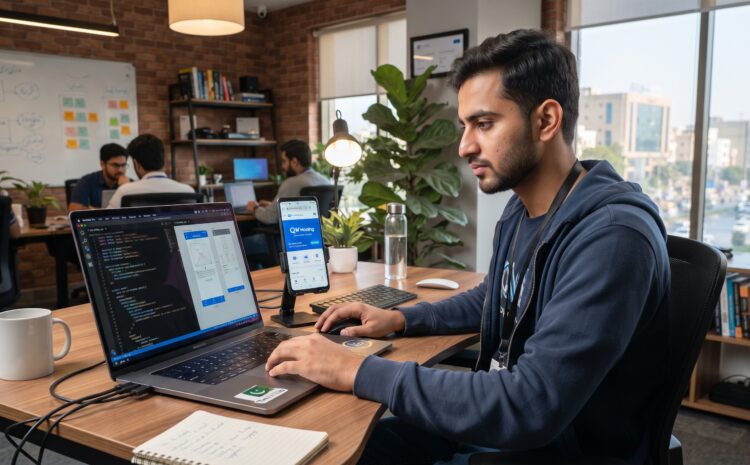
Mobile App Development in Pakistan: A Business Guide for 2026

Businesses across Pakistan are investing in digital services to make it easier for customers to discover products, book services, place orders, manage accounts, and communicate with support teams. A mobile application can bring these activities into one convenient experience, but building a successful app takes more than hiring a developer and publishing something on Google Play.
The right solution depends on your business model, target audience, budget, security requirements, and plans for future growth. A small retailer may need a straightforward shopping app, while a logistics company might require live tracking, driver accounts, customer notifications, and a management dashboard.
If you are researching mobile app development in Pakistan, this guide explains the available services, technology choices, development process, estimated costs, and questions to ask before selecting a development partner.
For businesses evaluating digital solutions, QW HOSTING provides a starting point for exploring web and technology services. Visit QW HOSTING to learn more about the company and its online presence.
What Is Mobile App Development?
Mobile app development is the process of planning, designing, programming, testing, launching, and maintaining software for smartphones and tablets. Depending on the project, an application may run on Android, iOS, or both platforms.
A mobile app can work independently or connect to a website, database, payment provider, customer relationship management system, inventory platform, or other business software.
For example, a retailer might use an app to display products, accept orders, and send delivery updates. A property company could let users browse listings and arrange viewings. A service provider might allow customers to schedule appointments, upload documents, and track requests.
The objective should be to solve a genuine customer or operational problem. An app is not automatically valuable simply because a business has one. If a mobile-friendly website already meets customer needs, improving that website could be the better first investment.
Why Businesses in Pakistan Are Considering Mobile Applications
Pakistan has an active technology and digital services sector. According to the State Bank of Pakistan’s FY2024–25 annual reporting, ICT services exports reached approximately US$3.8 billion, increasing by 18.3% during the fiscal year. This figure covers a broad range of information and communication technology services, not mobile app development alone, but it illustrates the scale of Pakistan’s technology services economy.
Source: State Bank of Pakistan, Annual Report FY2024–25.
Businesses can consider several practical reasons for investing in mobile software.
1. Easier access to customers
Customers may prefer to complete common tasks from their phones rather than repeatedly visit a physical location or navigate a complicated website. An app can make frequently used services easier to access through saved preferences, account details, notifications, and simplified navigation.
2. Better customer service
An application can provide order tracking, appointment management, frequently asked questions, support requests, and service updates. These features may reduce repetitive enquiries and give customers a clearer view of what happens after they place an order or submit a request.
3. More organised business operations
A well-designed app connected to an administration system can help businesses manage bookings, orders, customer information, and internal workflows. However, the underlying processes must be designed properly. An app cannot fix unreliable inventory data or inconsistent service delivery by itself.
4. New digital business models
Mobile technology can support subscription services, marketplaces, on-demand services, digital learning, delivery platforms, and software products. Startups can begin with a limited set of features, test the business idea, and expand when customer demand justifies further investment.
5. Opportunities beyond Pakistan
Companies serving international clients may use mobile applications to deliver digital products to customers in the Middle East, Europe, North America, and other markets. International projects may require additional work involving currencies, languages, privacy obligations, regional payment methods, and support arrangements.
Types of Mobile App Development Services in Pakistan
Before requesting a quote, identify the kind of application your business actually needs. The category affects the technology, development schedule, testing requirements, and budget.
Android app development
Android development targets devices running Google’s Android operating system. It can be suitable for consumer apps, business tools, retail applications, booking systems, and employee-facing software.
Depending on the project, developers may use Kotlin and Android’s native development tools or a cross-platform framework. The decision should reflect the required device features, performance, budget, and long-term maintenance plan.
iOS app development
iOS applications are built for Apple’s mobile devices. Native development commonly uses Swift and Apple’s development frameworks.
An iOS app may be appropriate when a business has a significant iPhone user base, needs close integration with Apple platform features, or intends to launch a premium consumer product. The decision should be based on audience research rather than an assumption that every business must launch on both platforms immediately.
Cross-platform app development
Cross-platform development allows a team to build applications for more than one mobile operating system using a shared codebase for much of the product.
Flutter and React Native are two commonly considered technologies. They can help businesses reduce duplicated development work, although the final cost depends on the design, integrations, platform-specific requirements, and testing effort.
Cross-platform does not mean that every feature will work identically without additional development. Some projects still require native code or separate platform-specific components.
E-commerce app development
An e-commerce application can include product catalogues, search, filters, customer accounts, shopping carts, checkout, order history, and delivery notifications.
Businesses selling in Pakistan should consider local payment preferences, cash-on-delivery workflows where relevant, delivery coverage, returns, customer support, and the reliability of inventory information. A successful shopping app needs a dependable operational process behind the interface.
On-demand and service booking apps
Booking applications can support salons, clinics, consultants, repair services, transport providers, training centres, and other service businesses.
Features may include service listings, appointment slots, provider profiles, booking confirmations, cancellations, reminders, and online payments. Multi-provider platforms may also need separate accounts for customers, service providers, and administrators.
Marketplace app development
A marketplace connects different groups, such as buyers and sellers, customers and service providers, or event organisers and venues.
These applications are usually more complex than a basic company app. They may need vendor onboarding, product or service listings, commission calculations, messaging, payment reconciliation, dispute handling, reviews, and moderation.
Marketplace projects should define how transactions work before development begins. Payment handling, refunds, fraud prevention, and disputes can affect the entire architecture.
Enterprise and internal business apps
Companies may need apps for sales teams, field workers, inventory management, inspections, logistics, employee requests, or reporting.
An internal application might not need a public app-store launch. A secure web application or a mobile-friendly internal portal could meet the requirement at a lower cost. A developer should compare these alternatives before recommending a full native app.
How Much Does Mobile App Development Cost in Pakistan in 2026?
There is no single reliable price for every mobile app. A simple information app and a multi-vendor platform are different engineering projects, even if both appear as icons on a smartphone.
Published Pakistani development-company estimates vary considerably. The following figures are indicative planning ranges, not verified national averages or a price quotation from QW HOSTING. Actual costs depend on the project’s scope and the provider’s team and delivery model.
Estimated development budget by project type
| Project type | Indicative budget | Typical scope |
|---|---|---|
| Basic app or prototype | PKR 150,000–400,000 | Limited screens, simple workflows, minimal integrations |
| Standard business app | PKR 400,000–1,200,000 | Custom interface, user accounts, basic backend |
| Feature-rich business app | PKR 1,200,000–3,500,000 | Payments, notifications, dashboards, multiple workflows |
| Marketplace or on-demand platform | PKR 1,500,000–4,000,000+ | Multiple user roles, advanced workflows, integrations |
| Enterprise or regulated application | PKR 4,000,000+ | Complex infrastructure, security, integrations, specialist requirements |
These ranges overlap because the feature set matters more than the label assigned to an app. A simple app with a complicated third-party integration may cost more than a larger catalogue application.
For context, published 2026 estimates from Pakistani software companies show wide price differences between basic projects, production-ready business apps, and complex platforms. See this 2026 pricing guide from R Technologies and compare its assumptions with your own requirements before using any estimate in a budget.
Estimated project budget comparison
The chart below visualises the indicative planning ranges above. It uses the lower end of each category’s budget as a starting point, not as a guaranteed development price.
| Project category | Starting budget |
|---|---|
| Basic app or prototype | PKR 150,000 |
| Standard business app | PKR 400,000 |
| Feature-rich business app | PKR 1,200,000 |
| Marketplace or on-demand app | PKR 1,500,000 |
| Enterprise or regulated app | PKR 4,000,000 |
Text chart: Indicative starting budget in Pakistan
- Basic app: PKR 150K ▉
- Standard business app: PKR 400K ▉▉
- Feature-rich business app: PKR 1.2M ▉▉▉▉
- Marketplace app: PKR 1.5M ▉▉▉▉▉
- Enterprise app: PKR 4M+ ▉▉▉▉▉▉▉▉▉▉
Chart note: This is an illustrative comparison of estimated starting budgets, not audited industry data. The categories are not perfectly comparable, and actual project quotes can fall outside these ranges.
What affects the final price?
Number of platforms: Building separate native Android and iOS apps may require more work than using a shared cross-platform codebase.
Feature complexity: Authentication, live tracking, chat, payment processing, offline functionality, and sophisticated search all add design, development, and testing work.
Backend development: Many apps require an API, database, administration panel, reporting tools, and secure business logic. These components can represent a substantial part of the total project.
Third-party integrations: Payment providers, maps, SMS gateways, accounting software, CRM platforms, and external APIs may involve development fees or ongoing usage charges.
Design and accessibility: A polished interface needs more than attractive screens. It should support clear navigation, readable text, useful error messages, and a range of devices.
Security and compliance: Applications handling personal information, financial activity, or sensitive records may need additional access controls, security testing, audit trails, and specialist review.
Maintenance: Operating system updates, bug fixes, server costs, monitoring, and feature improvements continue after launch. Ask the developer to separate one-time development fees from recurring operating costs.
Choosing the Right Technology for Your App
Technology should follow the product requirements, not trends or a developer’s personal preference.
| Technology | Often suitable for | What to consider |
|---|---|---|
| Kotlin | Native Android apps | Android-specific development and maintenance |
| Swift | Native iOS apps | Apple platform expertise and device testing |
| Flutter | Cross-platform mobile apps | Shared codebase, plugins, and platform-specific needs |
| React Native | Cross-platform mobile apps | JavaScript ecosystem, native integrations, and team experience |
| Backend APIs and databases | Apps requiring shared data and business logic | Security, hosting, reliability, backups, and scalability |
A development team should explain why it recommends a particular stack and what that choice means for maintenance, future hiring, performance, and ownership.
For a first version of a business product, Flutter or React Native may be worth evaluating. For apps requiring specialised device functionality or highly platform-specific experiences, native development may be more appropriate.
The best choice is the one that meets the product’s requirements without creating unnecessary complexity.
The Mobile App Development Process
A structured process makes projects easier to estimate, review, and manage. Businesses should know what they will receive at every stage before development starts.
1. Discovery and requirements
The project begins by defining the business problem, intended users, essential features, competing solutions, and success measures.
The team should document the scope, assumptions, dependencies, integrations, and exclusions. It should also identify which features are necessary for the first release and which can wait.
2. Wireframes and user experience
Wireframes show the app’s screen structure and navigation before detailed visual design begins. They help the business check the user journey without paying to build every screen first.
For a Pakistani audience, the design may need to account for different device sizes, variable connectivity, language preferences, and customers who are unfamiliar with complicated digital workflows.
3. UI design and technical planning
The design stage defines the interface, typography, colours, reusable components, and interaction patterns.
At the same time, the team plans the backend, data model, API connections, access controls, hosting, and deployment approach. This stage should produce a clear view of how the application will work as a complete system.
4. Development
Developers build the mobile interface and supporting systems according to the approved scope. Work is often divided into milestones so the client can review progress and raise concerns before the project reaches completion.
A business should ask for regular demonstrations and a way to track tasks, defects, and scope changes.
5. Quality assurance and security testing
Testing should cover the application’s main workflows, different screen sizes, poor connectivity, error conditions, performance, and compatibility with supported devices.
Where appropriate, the team should also test authentication, permissions, sensitive data handling, API access, and payment-related workflows. A successful demonstration is not a substitute for testing.
6. Launch and store submission
The team prepares the release, store listing, screenshots, privacy information, and required configuration. Apple and Google have their own review processes, and approval cannot be guaranteed by a developer.
The client should own the relevant developer accounts or have a clearly documented arrangement that protects ownership and access.
7. Maintenance and improvement
After launch, the team monitors issues, reviews user feedback, fixes defects, and plans updates.
Useful measures include crash rates, completed transactions, user retention, conversion rates, support requests, and the time needed to complete important tasks. Downloads alone do not prove that an app is delivering business value.
Features Every Business Should Consider
The required features depend on the app’s purpose. Adding every available feature to the first release can increase cost and delay launch without improving the core experience.
Consider these areas during planning:
- User accounts: Registration, login, password recovery, and appropriate account protection.
- Notifications: Useful alerts for bookings, orders, service changes, or other relevant events.
- Administration: A secure dashboard to manage content, users, orders, or business records.
- Analytics: Measurement of important actions and product performance.
- Customer support: A practical way to report problems or request help.
- Payments: Appropriate payment methods, transaction status, receipts, and refund workflows.
- Data protection: Collection of only the information needed, clear privacy information, and controlled access.
- Accessibility: Readable content, clear labels, understandable error messages, and usable navigation.
- Backup and recovery: A plan for restoring important data and responding to operational failures.
Features should be prioritised according to user needs, business risk, and measurable value.
Mobile App Development for Different Pakistani Industries
Pakistan’s businesses have different operating conditions and customer expectations. A useful application reflects the actual workflow of its industry rather than using a generic template for every sector.
Retail and e-commerce
Retail apps can support product browsing, inventory visibility, checkout, order updates, and customer accounts. Integration with existing stock and order systems helps avoid conflicting records.
Businesses should plan for cancellations, returns, customer support, and delivery status changes. These processes are as important as the product catalogue.
Real estate
A property application may include listing search, photos, location information, enquiry forms, viewing appointments, and agent dashboards.
The business should define how listings are verified, how availability is updated, and who is responsible for correcting inaccurate property information. Search filters and map features should help users find relevant properties rather than simply add complexity.
Healthcare and appointment booking
Appointment applications may help patients find services, request appointments, receive reminders, and communicate with a provider.
Health-related data requires particular care. Access should be restricted to authorised users, and the organisation should seek appropriate legal and security guidance for the information it handles. A standard booking app should not be represented as a compliant medical records platform without the required work and verification.
Education and training
Educational apps can offer lesson access, assignments, schedules, progress tracking, and communication between students and institutions.
The design should account for connectivity constraints and the devices commonly used by the target audience. If users need offline access, it should be specified and tested rather than assumed.
Logistics and field services
Logistics apps may combine driver workflows, location tracking, delivery confirmation, dispatch management, and operational reporting.
Live tracking and background location services can add technical and privacy considerations. Businesses should define when location data is collected, who can see it, and how long it is retained.
Hospitality and tourism
Hotels, restaurants, venues, and travel companies may use apps for reservations, service requests, event information, loyalty programmes, and customer communication.
Before commissioning an app, compare the cost of a dedicated mobile product with a well-built mobile website and a booking platform. A native app is most useful when customers have a clear reason to return and use its specialised features.
How to Select a Mobile App Development Company in Pakistan
The cheapest quote is not necessarily the best value. The most expensive proposal is not automatically the strongest either. Compare providers against a consistent set of requirements.
Review relevant experience
Ask to see examples of applications with similar workflows, integrations, or technical challenges. Confirm what the provider actually delivered and which elements were handled by other parties.
Do not rely on screenshots alone. Where possible, test a live application and ask about its maintenance, performance, and support arrangements.
Request a clear proposal
A professional proposal should describe the scope, deliverables, milestones, estimated schedule, payment terms, assumptions, exclusions, and change-request process.
Ask whether UI design, backend development, administration tools, testing, deployment, and post-launch support are included. A low initial price may cover only a portion of the work.
Confirm ownership
The contract should clarify ownership of the source code, design assets, documentation, databases, and project-specific intellectual property.
Developer accounts, domain names, cloud accounts, and API credentials should be managed through an arrangement that gives the business appropriate control. Access and handover procedures should be documented before the project begins.
Ask about communication
Confirm who will manage the project, how frequently progress will be reported, and how issues will be escalated.
Regular demonstrations and written milestone approvals reduce the risk of discovering major misunderstandings near the end of the project.
Understand the support model
Ask what happens when the app crashes, a third-party service changes, or a mobile operating system update causes a problem.
A maintenance agreement should define response times, support hours, included fixes, exclusions, and charges for new features. Avoid relying on vague promises of unlimited or lifetime support.
Check security and data handling
Ask how the provider manages access permissions, protects credentials, handles backups, and responds to security incidents. Applications processing payments or sensitive personal data may require specialist security and compliance review.
Red Flags to Watch for Before Signing
Take extra care if a provider:
- Promises a complex, fully custom application in an unrealistically short period.
- Offers a fixed price without asking about the required features.
- Refuses to document deliverables or ownership.
- Cannot explain how the backend, integrations, and data storage will work.
- Requests that all developer accounts remain permanently under its exclusive control.
- Claims guaranteed app-store approval, guaranteed revenue, or guaranteed search rankings.
- Has no clear plan for testing, maintenance, or handover.
These points do not automatically prove that a provider is unreliable, but they are reasons to ask for more detail before committing.
How to Reduce Development Costs Without Sacrificing Quality
Cost control starts with deciding what the first release must accomplish.
Build an MVP. A minimum viable product focuses on the essential workflow needed to test demand. For example, a booking app may initially support service listings, available slots, booking confirmation, and an administration dashboard. Loyalty points and advanced personalisation can follow later.
Prioritise by impact. Separate essential features from useful improvements and optional extras. Ask which requirement supports the core business objective and which can wait.
Use existing systems where sensible. If a reliable inventory, CRM, or accounting platform already exists, integrating it may be better than rebuilding the same functionality.
Choose the platform strategically. A cross-platform application, progressive web app, or responsive website may be sufficient for some projects. Compare these options against the actual requirements.
Document the scope. Clear requirements reduce avoidable rework and disagreements over what was included in the price.
Plan for maintenance. A cheaper launch can become expensive if the app is difficult to update or depends on undocumented code. Maintainable architecture and proper handover are part of the total investment.
SEO, Security, and Privacy Considerations for App-Based Businesses
A mobile application and a website serve different purposes. An app can support returning users, while a public website often helps people discover a business through search.
If your business depends on organic traffic, maintain useful public pages describing your services, products, pricing approach, locations, and contact options. Do not assume that publishing an app automatically improves your website’s rankings.
For Google Search, the fundamentals remain important: accessible pages, helpful content, appropriate internal links, accurate metadata, and a sound technical setup. Google’s official guidance says AI Overviews and AI Mode do not require a separate set of special SEO optimisations. The same foundational SEO principles apply to these experiences.
Read Google’s guidance on AI features and your website and its guidance on generative AI content.
For applications, security and privacy should be part of the design from the beginning. Explain what information is collected and why. Restrict access to authorised people, protect secrets, and establish a process for handling incidents and deletion requests where applicable.
Businesses operating in regulated sectors or serving customers in other countries should obtain advice on the legal requirements relevant to their specific activities. Compliance should not be claimed simply because an application includes a privacy policy.
Frequently Asked Questions
How much does mobile app development cost in Pakistan?
The cost depends on the scope, technology, integrations, and testing requirements. A simple app may fit within a few hundred thousand rupees, while a production-ready business application or complex marketplace can cost several million rupees or more. Request a written, itemised quote based on your actual requirements.
How long does it take to develop a mobile app?
A basic app may take several weeks, while a feature-rich business application may require several months. Multi-sided platforms and enterprise systems can take longer. The schedule depends on design approval, integrations, testing, team availability, and changes to the agreed scope.
Should I build an Android app, an iOS app, or both?
Choose based on your audience and business requirements. If most of your intended customers use Android, an Android-first release may be a sensible starting point. If you need both platforms, compare native development with cross-platform technologies such as Flutter and React Native.
Is Flutter suitable for business applications?
Flutter can be suitable for many business apps, including booking, retail, and service platforms. Its suitability depends on the required integrations, device features, performance needs, and the development team’s experience. It should be assessed against the project rather than selected automatically.
Do I need a website as well as a mobile app?
Not always, but a website can help people discover your business, understand your services, and contact you without installing an application. Many businesses benefit from a mobile-friendly website alongside an app designed for repeat use.
What should a mobile app development contract include?
It should describe the deliverables, scope, milestones, payment terms, ownership, third-party costs, testing, acceptance criteria, change requests, support, and handover arrangements. It should also explain how delays or disagreements will be managed.
Who owns the app after development?
Ownership depends on the contract and applicable law. Make sure the agreement clearly covers source code, designs, documentation, project-specific intellectual property, and access to the necessary accounts. Do not assume ownership is automatically transferred just because the final payment has been made.
Can an existing website be turned into an app?
Sometimes. A website can be connected to an app or packaged for certain use cases, but a simple web wrapper may not deliver the experience or platform functionality users expect. Evaluate whether customers need an app or whether improving the mobile website would be more effective.
How do I know whether my app is successful?
Measure outcomes tied to your business objective. Depending on the product, these may include completed bookings, repeat purchases, successful payments, active users, retention, reduced support workload, or shorter processing times. Downloads alone are not enough to demonstrate success.
Final Thoughts: Plan Your Mobile App Around Your Business Goals
Mobile app development in Pakistan offers businesses a way to improve customer access, simplify workflows, and build digital products for local and international markets. The right investment begins with a clear problem, a realistic scope, and a development plan that accounts for maintenance as well as launch.
Before selecting a provider, compare the proposed features, technical approach, delivery schedule, ownership terms, security practices, and support model. Ask for a detailed proposal and confirm what the price includes.
For companies exploring their next digital project, visit QW HOSTING to learn more about its online presence and technology services. Explain your business objectives, intended users, required features, and budget when making an enquiry so that the project can be evaluated against practical requirements.
A successful app is not simply one that reaches an app store. It is one that solves a real problem, works reliably, protects users, and delivers value that justifies its ongoing cost.