
Coming: "Nutrition labels" for internet service – Axios

Atlanta
Austin
Charlotte
Chicago
Columbus
Dallas
Denver
Des Moines
Nashville
NW Arkansas
Philadelphia
Tampa Bay
Twin Cities
Washington D.C.
Menu
Get smarter, faster about your hometown.
Access hyper-relevant news analysis for your industry.
Please enter a valid email.
Please enter a valid email.
Please enter a valid email.
Please enter a valid email.
Please enter a valid email.
Please enter a valid email.
Please enter a valid email.
Please enter a valid email.
Please enter a valid email.
Please enter a valid email.
Please enter a valid email.
Please enter a valid email.
Please enter a valid email.
Please enter a valid email.
Please enter a valid email.
Please enter a valid email.
Please enter a valid email.
Please enter a valid email.
Please enter a valid email.
Please enter a valid email.
Please enter a valid email.
Please enter a valid email.
Please enter a valid email.
Please enter a valid email.
Please enter a valid email.
Please enter a valid email.
Please enter a valid email.
Please enter a valid email.
Please enter a valid email.
Please enter a valid email.
Please enter a valid email.
Please enter a valid email.
Please enter a valid email.
Please enter a valid email.
Please enter a valid email.
Please enter a valid email.
Please enter a valid email.
Please enter a valid email.
Please enter a valid email.
Please enter a valid email.
Please enter a valid email.
Please enter a valid email.
Please enter a valid email.
Please enter a valid email.
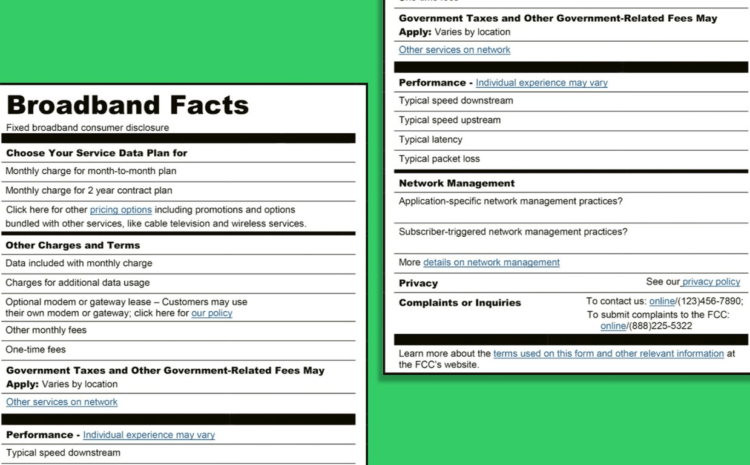
An example broadband label from the FCC in 2016. Source: FCC
The FCC will vote Thursday on a proposal to make companies cough up the details of their internet speeds and prices in easy-to-read "broadband nutrition labels."
Why it matters: The communications regulator is newly flexing its muscles over cable and telecom companies in an attempt to make it easier for consumers to comparison shop for high-speed internet.
Driving the news: The FCC proposal would require internet service providers to create labels with information about prices, promotional rates, internet speeds, data allowances and other details.
What they're saying: "This is something that is an everyday necessity, and consumers deserve some real, basic information," Jonathan Schwantes, senior policy counsel for Consumer Reports, told Axios.
The other side: “We agree with the commission that consumers should have the information they need to shop between competing providers — and they already do,” USTelecom said to Axios in a statement.
Context: The FCC's vote comes less than a week after chairwoman Jessica Rosenworcel circulated a measure to her fellow commissioners that would ban practices she says reduce competition among internet service providers in apartment buildings.
Between the lines: Rosenworcel will need the support of at least one of the Republican commissioners at the agency to advance both the broadband label and the apartment building items, as the Senate has yet to confirm a Biden nominee, Gigi Sohn, as the third Democrat on the five-member commission.
The big picture: Both the internet proposals were part of Biden's executive order in July on increasing competition throughout the economy.
Tesla debuts the Cybertruck in Hawthorne, Calif., on Nov. 21, 2019. Photo: Frederic J. Brown/AFP via Getty Images
Tesla is at risk of falling behind on one of the most critical products in the American auto industry: pickups.
Why it matters: Pickups are the most profitable segment in the business and account for the first, second and third best-selling vehicles in the country. Without a serious pickup strategy, Tesla could miss out on a huge source of future income.
Secretary of Defense Lloyd Austin speaks during a news conference at the Pentagon in Arlington, Virginia on Sept. 1, 2021. Photo: Andrew Harrer/Bloomberg via Getty Images
Defense Secretary Lloyd Austin issued a directive Thursday to improve the U.S. military's approach to civilian harm mitigation and response, calling it a "strategic and a moral imperative."
Why it matters: The Pentagon has faced criticism for years for amassing civilian casualties in its missions, especially in the Middle East. New York Times investigations have found systemic failures in efforts to prevent civilian deaths, as well as a cover-up of a 2019 airstrike that killed dozens of women and children in Syria.
The most corrupt governments in the world are in South Sudan, Syria and Somalia, according to Transparency International's annual index, while the "cleanest" are in Denmark, Finland and New Zealand.
source