
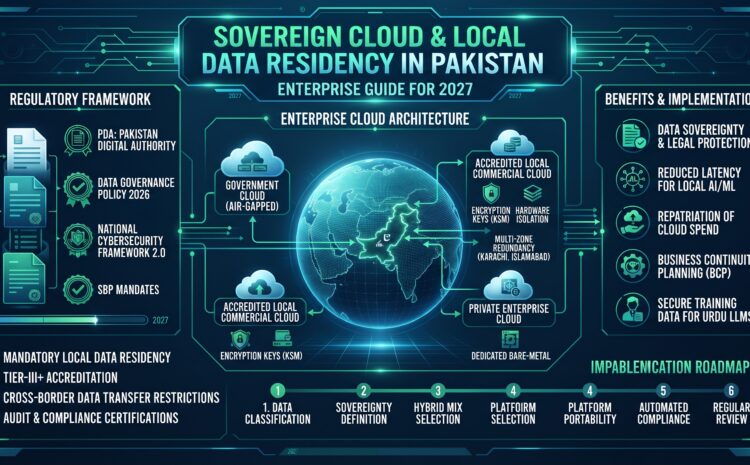
Sovereign Cloud & Local Data Residency in Pakistan. Enterprise Guide for 2027

Businesses are moving more of their operations to cloud infrastructure. Customer records, financial documents, business applications, backups, analytics platforms, and internal communications now depend on digital systems hosted by third-party providers.
But for enterprises, hosting capacity and performance aren’t the only questions.
Where is the data physically stored? Who can access it? Which country’s laws apply? Can the organisation control where its information moves? And can the business retrieve its data if the cloud provider changes?
These questions have made sovereign cloud and local data residency important considerations for enterprise IT, financial institutions, government organisations, healthcare providers, telecommunications companies, and businesses handling sensitive information.
In Pakistan, the conversation has become particularly relevant following the government’s Pakistan Cloud First Policy, cloud provider accreditation framework, and growing focus on locally hosted digital infrastructure.
For organisations planning cloud infrastructure in 2027, understanding data residency and sovereignty can help inform procurement decisions, security planning, compliance reviews, and long-term technology strategy.
QW HOSTING explores what sovereign cloud means, how local data residency works, the differences between cloud models, what Pakistan’s policy framework says, and how enterprises can evaluate a cloud provider before moving sensitive workloads.
Table of Contents
- What Is Sovereign Cloud?
- What Is Local Data Residency?
- Sovereign Cloud vs Data Residency vs Data Sovereignty
- Why Data Residency Matters for Pakistani Businesses
- Pakistan’s Cloud First Policy and Local Cloud Infrastructure
- Pakistan’s Regulatory and Compliance Considerations
- Cloud Deployment Models Compared
- Sovereign Cloud Architecture and Security
- Regional Data and Enterprise Cloud Planning
- Industries That May Benefit from Sovereign Cloud
- How to Choose a Cloud Provider in Pakistan
- Cloud Migration and Data Residency Checklist
- Sovereign Cloud Costs and Commercial Considerations
- Frequently Asked Questions
- Conclusion
What Is Sovereign Cloud?
A sovereign cloud is a cloud computing environment designed to provide an organisation with greater control over its data, infrastructure, access, governance, and legal obligations within a defined jurisdiction.
The exact meaning varies between providers. The term isn’t a universal certification that automatically guarantees data protection or regulatory compliance.
A sovereign cloud arrangement may include controls such as:
- Data storage within a specified country.
- Local operational and administrative control.
- Defined restrictions on access by foreign entities.
- Jurisdiction-specific governance.
- Security controls and independent audits.
- Encryption and key management.
- Local incident response capabilities.
- Contractual restrictions on data transfer.
- Data ownership and exit provisions.
- Monitoring of privileged administrative access.
For example, a Pakistani organisation may want its sensitive customer records hosted in Pakistan, managed under a contract that defines access restrictions, backup locations, security responsibilities, and how the organisation can retrieve its data.
The organisation may choose a local provider, a dedicated private cloud, or an appropriately governed cloud service.
However, simply purchasing a server located in Pakistan doesn’t automatically make the environment sovereign.
The organisation must also understand who operates the infrastructure, who controls encryption keys, where backups are stored, which support personnel can access systems, and which legal obligations apply to the provider and its parent companies.
What sovereign cloud is designed to address
The main objective is to reduce uncertainty around the organisation’s control of information and infrastructure.
A well-designed sovereign cloud arrangement can help a business address:
Jurisdictional risk. Understanding which laws and legal processes may apply to stored information.
Operational control. Defining who administers infrastructure and how privileged access is managed.
Data movement. Restricting where primary data, backups, logs, and replicas may be transferred.
Compliance requirements. Supporting internal governance, contractual requirements, and applicable sector-specific rules.
Business continuity. Establishing how data can be recovered, transferred, or migrated if the service changes.
Sovereignty is therefore a combination of technology, governance, legal arrangements, and operational practices.
What Is Local Data Residency?
Local data residency means that data is stored within a specified geographic location, such as Pakistan.
A company may choose local data residency because of internal policies, customer contracts, regulatory obligations, government procurement requirements, latency considerations, or risk management.
The important question is what exactly remains inside the country.
A cloud provider may advertise a local data centre while some associated services operate elsewhere. Depending on the configuration, information may travel outside the selected region through backups, monitoring systems, support tools, analytics services, or third-party integrations.
For an enterprise, local data residency should be defined clearly in the contract and technical architecture.
Which data should be included in residency requirements?
A data residency assessment should consider more than the primary database.
| Data type | Residency question |
|---|---|
| Primary application data | Where are production databases and files stored? |
| Backups | Are backup copies stored within Pakistan? |
| Disaster recovery | Where is the secondary recovery environment? |
| Logs | Do application and security logs contain personal or confidential information? |
| Metadata | Where are account details, usage records, and system metadata processed? |
| Encryption keys | Who controls the keys and where are key management systems operated? |
| Support access | Can technical support staff access information from another country? |
| AI processing | Are documents or customer information sent to an external AI service? |
| Replication | Can information be copied automatically to another region? |
| Third-party integrations | Do connected applications transfer data outside the required jurisdiction? |
These details should be reviewed before an organisation signs a cloud contract.
A provider’s statement that it has a data centre in Pakistan is useful, but it doesn’t answer every residency question.
Sovereign Cloud vs Data Residency vs Data Sovereignty
These terms are related, but they describe different aspects of cloud governance.
| Concept | Meaning | Main concern |
|---|---|---|
| Data residency | Where information is physically stored | Geographic location |
| Data sovereignty | Which jurisdiction’s laws and authority may apply to information | Legal control |
| Sovereign cloud | Cloud environment designed to provide defined jurisdictional, operational, and governance controls | Control, governance, security, and jurisdiction |
| Private cloud | Dedicated cloud infrastructure for one organisation | Isolation and control |
| Local hosting | Infrastructure physically hosted within a country | Location and infrastructure access |
Example
Suppose a company stores its business records in a data centre located in Karachi.
That may satisfy a geographic storage requirement.
But if the cloud provider’s support team is located overseas, encryption keys are controlled by a third party, backups are replicated internationally, or the service is operated by a foreign entity subject to different legal obligations, the company’s sovereignty assessment may be more complicated.
Local storage and sovereign control aren’t interchangeable.
An enterprise should evaluate the full service arrangement rather than relying on the data centre address alone.
Why Data Residency Matters for Pakistani Businesses
Pakistan’s businesses are becoming increasingly dependent on digital infrastructure. Cloud services support customer portals, enterprise applications, financial systems, online stores, document management, analytics, and remote operations.
For organisations handling sensitive information, the location and control of data can influence procurement decisions.
1. Regulatory and contractual requirements
Some organisations may have requirements arising from regulations, sector-specific policies, customer contracts, government procurement rules, or internal security standards.
A company serving a regulated client may be asked to demonstrate where data is stored, who can access it, and how it is protected.
These requirements can affect which cloud provider is suitable.
2. Greater control over sensitive information
Local infrastructure can help organisations define geographic boundaries for data storage and recovery.
This may be relevant for government records, financial information, identity records, confidential business documents, and other sensitive information.
3. Procurement requirements
Enterprise customers increasingly ask technical and security questions before approving a supplier.
Cloud providers may need to explain infrastructure locations, security controls, certifications, incident response processes, subcontractors, and data ownership arrangements.
A clear residency model can help a provider respond to these procurement requirements.
4. Business continuity and disaster recovery
Data residency and disaster recovery need to be planned together.
If an organisation requires all data to remain in Pakistan, its recovery architecture must reflect that requirement. A secondary site in another country may conflict with the organisation’s policy or contractual obligations.
Local disaster recovery can be designed using a second geographic location within Pakistan, subject to available infrastructure and the required recovery objectives.
5. Customer trust
Businesses may want to explain how customer information is stored and protected.
A transparent privacy and security policy can help customers understand how their information is handled. It should be accurate and supported by actual infrastructure and contractual commitments.
Pakistan’s Cloud First Policy and Local Cloud Infrastructure
Pakistan introduced its Pakistan Cloud First Policy in February 2022 through the Ministry of Information Technology and Telecommunication.
The policy aims to encourage cloud adoption across public sector entities, improve ICT procurement, increase efficiency, support digital transformation, and establish a framework for cloud service providers serving government organisations.
The policy addresses cloud deployment models, data sovereignty and data flows, provider accreditation, procurement, governance, and cloud adoption.
Official policy document:
Pakistan Cloud First Policy, Ministry of IT and Telecommunication
What the policy means for government cloud procurement
The policy establishes an accreditation framework for cloud service providers serving public sector entities. It addresses security, reliability, cost, interoperability, availability, audit requirements, data ownership, and contractual arrangements.
The government framework is particularly relevant for companies planning to supply cloud services to public sector organisations.
Providers should review the applicable accreditation requirements and procurement framework rather than assuming that operating a local data centre alone makes them eligible.
Cloud provider accreditation
Pakistan’s cloud accreditation framework includes requirements relating to provider security, privacy, service management, data centre controls, certifications, documentation, and audit processes.
The official accreditation information is available through the Pakistan Cloud Office and the Accreditation Criteria for Cloud Service Providers.
Organisations procuring cloud services for public sector use should verify the provider’s current accreditation status and applicable requirements directly with the relevant authorities.
Data sovereignty and cross-border flows
The Pakistan Cloud First Policy discusses data sovereignty, data flows, and the implications of storing government information outside Pakistan.
It recognises that cloud services can offer efficiencies through international infrastructure while also identifying situations where geographic control and cross-border data movement require consideration.
This is an important distinction for enterprise cloud planning.
The policy is a framework for public sector cloud adoption and should not be interpreted as a blanket rule requiring every private company in Pakistan to store every category of information locally.
Businesses should determine which laws, policies, contractual terms, and sector-specific requirements apply to their particular workloads.
Pakistan’s Regulatory and Compliance Considerations
Data residency decisions should be based on the organisation’s legal and regulatory obligations, not marketing claims.
Pakistan has a range of laws, policies, and sector-specific frameworks that may affect data handling and technology outsourcing.
Pakistan Cloud First Policy
The policy is relevant to public sector cloud procurement and provides a broader framework for cloud adoption, provider accreditation, governance, data ownership, and data flows.
Official source:
State Bank of Pakistan cloud outsourcing framework
Financial institutions must pay close attention to outsourcing and cloud requirements issued by the State Bank of Pakistan.
SBP has issued frameworks addressing technology governance, outsourcing, and cloud service arrangements for regulated financial institutions.
The requirements vary depending on the institution, workload, type of information, and applicable framework.
Relevant sources include:
- SBP Framework on Outsourcing to Cloud Service Providers, 2023
- SBP Outsourcing to Cloud Service Providers, 2020
- SBP Enterprise Technology Governance and Risk Management Framework
Financial institutions should review the latest applicable SBP requirements and obtain compliance advice before selecting a cloud arrangement.
Personal data protection
Organisations processing personal information should review applicable Pakistani legislation, regulations, sector rules, contractual commitments, and current developments in data protection policy.
Do not assume that a data centre located within Pakistan automatically satisfies every privacy or data protection obligation.
A residency decision should be considered alongside collection, access, processing, retention, disclosure, security, and deletion practices.
For legal interpretation, consult qualified legal counsel and the relevant regulatory authority.
Government information security requirements
Government organisations and entities handling public sector information may have additional security, accreditation, procurement, and data classification requirements.
The cloud provider should be able to explain its certifications, audit processes, infrastructure controls, and compliance documentation relevant to the intended workload.
Cloud Deployment Models Compared
Different cloud deployment models offer different levels of isolation, control, cost, and operational responsibility.
The right model depends on the organisation’s workload, security requirements, compliance obligations, IT capacity, and budget.
Public cloud
Public cloud infrastructure is provided through shared services operated by a cloud provider.
Customers generally use logically isolated resources and pay according to their selected services and usage.
Public cloud can be suitable for websites, development environments, business applications, analytics, and workloads that can meet their security and compliance requirements in the chosen environment.
The organisation should confirm region availability, service-specific data handling, backup location, and contractual controls.
Private cloud
Private cloud infrastructure is dedicated to a single organisation.
It may be operated within the organisation’s own premises or by an external service provider.
Private cloud can offer more control over infrastructure, network configuration, access, and workload placement. It also requires appropriate management, security, capacity planning, and maintenance.
Hybrid cloud
Hybrid cloud combines different infrastructure environments.
For example, an organisation may keep a sensitive database in a private or locally hosted environment while using public cloud services for a website, collaboration, analytics, or non-sensitive workloads.
A hybrid design requires careful management of network connections, identity, encryption, access control, and data transfers.
Community cloud
Community cloud infrastructure is shared by organisations with common requirements, such as government entities or institutions operating under similar governance and security standards.
The shared environment may be designed around common requirements, but participating organisations still need to review responsibilities, access arrangements, and contractual controls.
Cloud model comparison table
| Cloud model | Control | Infrastructure | Typical use |
|---|---|---|---|
| Public cloud | Shared responsibility | Provider-managed shared infrastructure | Web applications, development, scalable workloads |
| Private cloud | Greater organisational control | Dedicated infrastructure | Sensitive applications, specialised workloads |
| Hybrid cloud | Distributed control | Combination of environments | Workloads with different data and performance requirements |
| Community cloud | Shared governance | Infrastructure shared by a defined group | Organisations with common requirements |
| Local dedicated hosting | Infrastructure control depends on agreement | Dedicated physical servers | Applications requiring dedicated resources or defined location |
The cloud model alone doesn’t determine whether an organisation meets its residency or sovereignty requirements.
The provider’s operational model, location, contracts, and technical controls must also be assessed.
Sovereign Cloud Architecture and Security
A sovereign cloud strategy should be based on a defined architecture rather than a single product name.
The design needs to identify which information is sensitive, where it may be stored, which systems may access it, and how the organisation will manage risk.
Data classification
Begin by identifying the information the organisation holds.
Possible categories include:
| Classification | Example | Typical handling |
|---|---|---|
| Public | Published website content | Public access |
| Internal | Internal procedures | Controlled employee access |
| Confidential | Contracts and business records | Restricted access and protection |
| Sensitive | Personal, financial, regulated, or security-sensitive data | Strong controls, defined access, and additional review |
The classification system should reflect the organisation’s policies and any applicable regulatory requirements.
Encryption
Encryption protects information from unauthorised access under appropriate conditions.
A cloud architecture may use encryption for stored data, network traffic, backups, and selected application workflows.
Encryption doesn’t automatically solve data residency. The organisation should also understand where keys are stored, who can manage them, and whether access is available to the provider or other parties.
Identity and access management
Access should be granted according to business responsibilities.
Use multi-factor authentication where appropriate, limit privileged accounts, review permissions regularly, and maintain logs of important administrative actions.
Shared administrator accounts should be avoided where individual accountability is required.
Network security
Cloud infrastructure may include private networks, firewalls, segmentation, VPNs, private connectivity, and restricted management access.
The design should separate public-facing services from sensitive internal systems where appropriate.
Backup and disaster recovery
A backup is useful only if the organisation can recover the information when required.
Define backup schedules, retention periods, recovery objectives, and restoration testing. Confirm the physical locations of backups and whether those locations meet residency requirements.
Audit and monitoring
A sovereign cloud arrangement should support suitable security monitoring, access records, incident response, and audit evidence.
The provider and customer should understand who is responsible for monitoring, investigating incidents, and notifying the other party.
Regional Data and Enterprise Cloud Planning
Pakistan’s cloud policy establishes a framework for public sector cloud adoption and provider accreditation. At the same time, the country’s enterprise requirements vary across government, financial services, private companies, and other sectors.
The following chart is a practical planning model, not a statistical measure of cloud adoption.
Enterprise cloud decision matrix
| Workload | Residency sensitivity | Suggested assessment |
|---|---|---|
| Public company website | Usually low | Assess availability, performance, security, and hosting location |
| Internal collaboration | Depends on information | Review vendor access, storage locations, and contracts |
| Customer database | Often high | Review data classification, residency, access, and applicable obligations |
| Financial records | High | Assess applicable financial sector and legal requirements |
| Government records | May be very high | Review Cloud First Policy, accreditation, classification, and procurement requirements |
| Disaster recovery | Depends on primary workload | Confirm backup and recovery locations |
| AI processing | Depends on input data | Review model provider, processing location, retention, and access |
A simple decision flow
Step 1. Identify the data.
What information will the workload process?
Step 2. Identify the requirements.
Does the information have a contractual, regulatory, government, or internal residency requirement?
Step 3. Select an architecture.
Could a public cloud service meet the requirements? Is private infrastructure necessary? Would hybrid cloud provide a better balance?
Step 4. Validate the provider.
Confirm physical locations, access controls, security documentation, backup arrangements, and contractual terms.
Step 5. Review the exit plan.
Determine how the business can retrieve its information and move the workload if the contract ends.
This process can help prevent enterprises from selecting a cloud service based on price or advertised location alone.
Industries That May Benefit from Sovereign Cloud
Sovereign cloud and local data residency can be relevant to organisations that handle sensitive records or operate under specific contractual and regulatory requirements.
Banking and financial services
Financial institutions need to evaluate cloud arrangements under applicable SBP frameworks and internal risk controls.
Data location is only one consideration. Security, outsourcing governance, access, auditability, business continuity, and operational risk are also important.
Government and public sector
Government organisations may have requirements relating to cloud provider accreditation, data classification, procurement, and public sector information handling.
Pakistan’s Cloud First Policy provides a framework for government cloud adoption.
Healthcare
Healthcare providers may process patient records, diagnostic information, appointments, and other sensitive data.
Cloud selection should consider privacy, access controls, security, contractual obligations, backup locations, and the applicable legal framework.
Telecommunications
Telecommunications businesses manage customer information, operational systems, network data, and business applications.
Cloud architecture may need to consider sector-specific requirements, operational resilience, data handling, and network integration.
Enterprise and industrial organisations
Manufacturing, logistics, energy, and large commercial organisations may use cloud infrastructure for operational reporting, supply chain systems, document management, and analytics.
Residency requirements can differ between business records, operational information, and customer data.
Software companies and B2B service providers
Software vendors may need to offer hosting options that meet the security and procurement requirements of enterprise customers.
A clear data residency statement, security documentation, and contractual controls can help answer customer due diligence questions.
How to Choose a Cloud Provider in Pakistan
Choosing a cloud provider is a commercial and technical decision.
An enterprise should compare providers based on its actual requirements rather than selecting one simply because it advertises a local data centre.
1. Confirm physical infrastructure locations
Ask for the locations of primary infrastructure, backup systems, disaster recovery facilities, and relevant supporting services.
Request written confirmation of the locations covered by the proposed service.
2. Review security controls
Ask about security management, access controls, encryption, monitoring, incident response, vulnerability management, and audit documentation.
Review certifications and reports relevant to the service being purchased. A certification held by a provider doesn’t necessarily cover every product, facility, or workload.
3. Understand administrative access
Ask who can access the infrastructure and data.
Review provider employees, subcontractors, support teams, privileged administrators, and third-party service providers.
Understand whether access is logged and whether customers can review relevant records.
4. Review data ownership
The organisation should retain appropriate ownership and rights over its data.
Contracts should define how the provider may process information, whether it can use the data for other purposes, and how access is controlled.
5. Confirm data portability
Ask how data can be exported, what formats are available, whether additional fees apply, and how long the migration process takes.
A cloud provider should have a clear exit process.
6. Evaluate performance and availability
Review network connectivity, service availability commitments, support arrangements, and recovery capabilities.
A local infrastructure location may be useful, but actual performance depends on the service architecture and network path.
7. Compare commercial terms
Consider the complete cost, including storage, computing, networking, backups, support, security services, migration, and data transfer.
Compare the contract and service levels, not only the monthly server price.
Cloud Migration and Data Residency Checklist
Before moving an enterprise workload, use the following checklist.
Governance
- Identify the data owner.
- Define the data classification.
- Identify applicable regulatory and contractual requirements.
- Document the required residency locations.
- Approve the cloud architecture.
Provider assessment
- Confirm primary infrastructure location.
- Confirm backup and disaster recovery locations.
- Review security certifications and audit evidence.
- Review administrative access arrangements.
- Check subcontractors and third-party dependencies.
- Confirm incident notification procedures.
Technical controls
- Configure encryption.
- Implement access controls.
- Enable suitable logging and monitoring.
- Review network security.
- Test backup restoration.
- Document recovery objectives.
Commercial and contractual
- Review the service agreement.
- Define data ownership.
- Confirm data transfer restrictions.
- Define support access.
- Review service levels.
- Confirm exit and migration terms.
- Document data deletion procedures.
Ongoing management
- Review access periodically.
- Monitor provider compliance.
- Update the data inventory.
- Test disaster recovery.
- Review contract renewals.
- Maintain an exit plan.
This checklist can be adapted to the organisation’s internal risk framework and applicable legal requirements.
Sovereign Cloud Costs and Commercial Considerations
Local cloud infrastructure may be priced differently from international hyperscale services. Costs depend on infrastructure capacity, service management, connectivity, security requirements, storage, backup, support, and contract terms.
A private cloud or dedicated infrastructure may provide greater isolation or control, but it can require more planning and management than a standard public cloud service.
Factors affecting cost
| Cost factor | What to consider |
|---|---|
| Compute | CPU, memory, workload capacity |
| Storage | Capacity, performance, redundancy |
| Network | Connectivity, bandwidth, transfer charges |
| Security | Firewalls, monitoring, encryption, access management |
| Backup | Retention, capacity, recovery |
| Disaster recovery | Secondary infrastructure and replication |
| Support | Managed services and response times |
| Migration | Application changes, data transfer, testing |
| Compliance | Assessments, audits, documentation |
| Exit | Export, migration, and transition costs |
How enterprises should compare quotations
Ask providers to quote the same workload assumptions.
For example, compare infrastructure with the same number of virtual machines, CPU and memory allocation, storage capacity, backup retention, bandwidth, support level, and security requirements.
Otherwise, a low quote may exclude services that another provider includes.
The organisation should also consider the cost of managing infrastructure internally. A cloud service that requires extensive staff involvement may not be cheaper when operational costs are included.
Frequently Asked Questions
What is sovereign cloud in simple terms?
Sovereign cloud is a cloud environment designed to provide defined controls over data, infrastructure, access, governance, and jurisdiction. The actual protections depend on the provider’s architecture, operating model, contracts, and security controls.
What is local data residency?
Local data residency means information is stored within a specified country or geographic region. For a Pakistani organisation, it may mean that defined categories of data remain on infrastructure physically located within Pakistan.
Is sovereign cloud the same as local hosting?
No. Local hosting refers primarily to where infrastructure is located. Sovereign cloud includes broader considerations such as legal jurisdiction, operational control, access, governance, and data handling.
Does Pakistan require every private company to store data locally?
No blanket conclusion should be drawn from the Pakistan Cloud First Policy. The policy primarily addresses public sector cloud adoption and provides guidance for broader cloud use. Private businesses should assess the requirements applicable to their industry, data, contracts, and services.
Is public cloud suitable for enterprise data?
It can be, depending on the workload and applicable requirements. Enterprises should review the provider’s security, data locations, access controls, contractual terms, and compliance suitability.
Is private cloud more secure than public cloud?
Not automatically. Security depends on architecture, configuration, management, access controls, monitoring, patching, and operational practices. A well-managed public cloud may be more secure than poorly managed private infrastructure.
Can a cloud provider store data in Pakistan and still have cross-border access?
Potentially, yes. Storage location and administrative access are separate issues. The provider’s legal structure, support operations, access permissions, and technical controls should be reviewed.
Where should cloud backups be stored?
Backup locations should be selected according to the organisation’s recovery objectives, security requirements, and residency obligations. If local residency is required, confirm that backup copies and recovery systems remain within the permitted locations.
What should an enterprise ask a cloud provider?
Ask about infrastructure locations, data ownership, encryption, administrator access, certifications, backup and recovery, incident response, service levels, migration, and data deletion.
Does sovereign cloud guarantee regulatory compliance?
No. Sovereign cloud may help meet specific requirements, but compliance depends on the organisation’s obligations and the complete service arrangement. Legal and regulatory review may still be necessary.
What is the difference between data residency and data sovereignty?
Data residency refers to where information is physically stored. Data sovereignty concerns the legal authority and jurisdiction that may apply to information. Both should be considered when evaluating cloud infrastructure.
Is sovereign cloud relevant to AI?
Yes. AI systems may process customer documents, business records, financial information, and confidential data. Organisations should understand where AI processing occurs, how inputs and outputs are stored, who can access them, and whether the service meets their residency requirements.
Conclusion
Sovereign cloud and local data residency are becoming important considerations in enterprise technology planning. For Pakistani businesses, the subject is relevant to public sector cloud procurement, regulated industries, enterprise customer requirements, security governance, and organisations managing sensitive information.
The Pakistan Cloud First Policy provides a framework for government cloud adoption, provider accreditation, data governance, and cloud procurement. Private organisations should separately assess their own regulatory, contractual, and operational requirements.
Choosing a cloud provider requires more than confirming the location of a data centre. Businesses should review infrastructure, access controls, security, backups, disaster recovery, data ownership, contractual protections, and exit arrangements.
For enterprise cloud planning in 2027, the best approach is to define the data requirements first, then select an architecture and provider that can demonstrate how those requirements will be met.
QW HOSTING provides technology and digital services for businesses exploring their infrastructure and online requirements. Organisations planning a website, cloud migration, enterprise hosting arrangement, or technology project can visit QW HOSTING to explore its services and discuss their requirements.


