
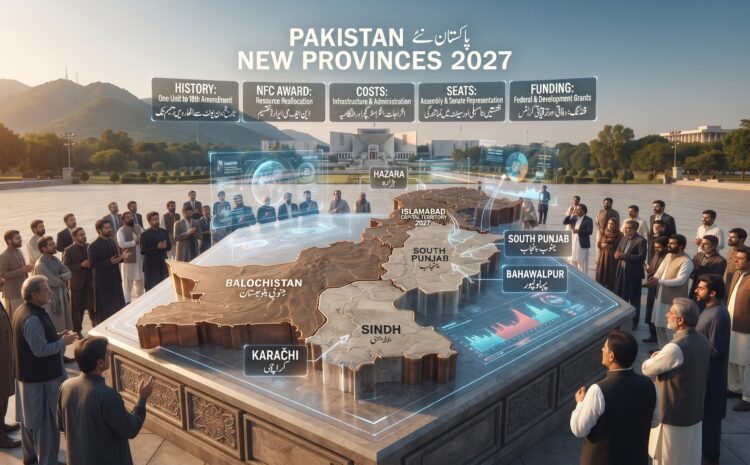
Pakistan New Provinces 2027: History, NFC, Costs, Seats and Funding

Pakistan’s debate over new provinces has returned to the national political agenda in 2026. Proposals involving South Punjab, Bahawalpur, Hazara, Karachi and wider administrative restructuring have raised an important question. Would creating more provinces make Pakistan easier to govern, improve public services, and distribute development funds more fairly, or would it create additional administrative costs and political complications?
The debate involves far more than changing a map. New provinces could affect the Constitution, National Finance Commission (NFC) transfers, Provincial Finance Commission (PFC) awards, development budgets, the number of Members of the National Assembly (MNAs) and Members of Provincial Assemblies (MPAs), government employees, police administration, courts, infrastructure, and the distribution of political power.
Pakistan has four provinces today. Proposals to create more administrative units have appeared repeatedly since independence, but none has completed the constitutional process required to establish a new province.
In November 2026, renewed political statements brought the issue back into the headlines. However, public discussion, political statements, proposed maps, and constitutional legislation are different stages. A proposal should not be described as an approved province until the required legal process is completed.
This article examines the history of Pakistan’s provincial structure, the current proposals, constitutional requirements, population and representation, NFC and PFC funding, PSDP and ADP development spending, the potential administrative costs, and the arguments for and against creating new provinces.
Table of Contents
- Pakistan New Provinces Debate in 2026
- Pakistan’s Provincial History Since 1947
- Why Pakistan Wants New Provinces
- Which New Provinces Are Being Proposed?
- Constitutional Requirements for Creating New Provinces
- Pakistan Population Data and Regional Distribution
- New MNA and MPA Seats
- NFC Award and Funding of New Provinces
- PSDP, ADP and Development Funds
- Provincial Finance Commission and Local Governments
- Administrative Costs of Creating New Provinces
- Economic Benefits and Potential Risks
- Fact Check. What Is Confirmed and What Is Not?
- International Examples of Administrative Restructuring
- What Would a Practical Provincial Reform Plan Look Like?
- Frequently Asked Questions
- Conclusion
1. Pakistan New Provinces Debate in 2026
The debate over Pakistan’s new provinces intensified during 2026 following statements by government officials and political leaders about possible administrative restructuring.
In August 2026, Dawn reported discussions involving proposals to divide Punjab into multiple units, divide Khyber Pakhtunkhwa, and consider changes involving Karachi and Gwadar. The discussions were described as being at an early stage rather than as a completed government plan.
In November 2026, international media also reported renewed statements from Defence Minister Khawaja Asif regarding the possibility of multiple new provinces. However, the same reporting noted that there was no publicly agreed number of provinces, final boundary plan, or formal constitutional amendment establishing the new units.
The political debate includes several different ideas, which should not be treated as one confirmed proposal.
| Proposal | Status as of November 2026 |
|---|---|
| South Punjab province | Longstanding political proposal |
| Restoration of Bahawalpur province | Historical and political demand |
| Hazara province | Longstanding regional demand |
| Karachi as a separate province | Politically controversial proposal |
| Division of Sindh into more units | Political discussion, not approved |
| Multiple provinces across Pakistan | Broader restructuring ideas under discussion |
| 28th Constitutional Amendment | Speculation and political discussion, no confirmed province-creation amendment enacted |
Recent reporting from Dawn, Al Jazeera, and other Pakistani news organisations shows that political statements and discussions have taken place. However, the exact structure of any future reform remains unsettled.
Sources for current developments:
- Dawn. New administrative units under serious consideration
- Dawn. Plan for new provinces faces political minefield
- Al Jazeera. Is Pakistan about to carve out new provinces?
The important distinction is that Pakistan is debating provincial restructuring. It has not legally created additional provinces through the process required by the Constitution.
2. Pakistan’s Provincial History Since 1947
Understanding the new provinces debate requires looking at Pakistan’s administrative history.
Pakistan in 1947
At independence, Pakistan inherited administrative structures from British India. The western part of Pakistan consisted of different administrative territories, including provinces and princely states, while East Bengal formed the eastern wing of the country.
The country faced major challenges involving migration, security, economic resources, integration of territories, and the development of national institutions.
The provincial structure changed several times during the early years.
The One Unit Scheme, 1955
In 1955, the One Unit Scheme combined the provinces and administrative territories of West Pakistan into a single province called West Pakistan.
The objective was to create administrative uniformity between East Pakistan and West Pakistan and simplify the federal structure.
However, the arrangement generated controversy. Smaller regions and ethnic groups argued that the unified western province weakened their political identity and representation.
Restoration of provinces in 1970
The One Unit system was abolished in 1970, and the provinces of Punjab, Sindh, Balochistan, and the then-North-West Frontier Province were restored.
The restoration of provincial identities became a major turning point in Pakistan’s administrative history.
The historical record matters because the current debate is not the country’s first attempt at provincial restructuring. Pakistan has already experienced both administrative consolidation and provincial restoration.
Official historical references include:
The 1971 separation of East Pakistan
The separation of East Pakistan and the creation of Bangladesh in 1971 remain a major part of Pakistan’s political history.
The crisis involved political representation, constitutional conflict, economic disparities, language, national identity, military action, and international involvement. It cannot accurately be explained by one administrative factor alone.
The experience continues to influence discussions about federalism, provincial autonomy, resource distribution, and political representation.
The 18th Constitutional Amendment
The 18th Constitutional Amendment, passed in 2010, significantly strengthened provincial autonomy and changed the federal-provincial division of responsibilities.
It expanded provincial responsibilities across several areas and reinforced the importance of provincial decision-making.
Any proposal to create new provinces must therefore consider not only territorial boundaries but also the division of responsibilities between federal and provincial governments.
Creating new provinces without a clear financial and administrative framework could create uncertainty over responsibilities for health, education, police, agriculture, infrastructure, and other public services.
3. Why Pakistan Wants New Provinces
Supporters of new provinces argue that existing provincial administrations are too large to manage local problems effectively.
Pakistan’s population has grown considerably, while provincial boundaries and administrative structures have remained largely unchanged since the restoration of the four provinces.
The argument is that smaller provinces could improve access to government, reduce regional disparities, and bring political decision-making closer to residents.
Better access to government
A resident of a remote district may have to travel a considerable distance to access provincial departments, senior officials, government hospitals, courts, or administrative offices.
A new province could establish institutions closer to the population it serves.
However, distance alone does not guarantee better services. A new province would need capable departments, staff, funding, roads, digital systems, and accountability mechanisms.
Regional development
Supporters of South Punjab, Hazara, and other regional proposals argue that their areas have not received adequate development relative to their needs.
They point to concerns about public hospitals, education, employment, roads, water supply, urban infrastructure, and representation in provincial decision-making.
A new province could potentially establish a more focused development budget and planning system.
Political representation
A smaller province could have its own chief minister, provincial cabinet, assembly, and departments.
This could allow local priorities to receive greater political attention.
But representation also depends on the electoral system, population, constituency boundaries, local government, and how political parties organise themselves.
Administrative efficiency
A provincial government located closer to the districts it manages may be able to respond more quickly to certain problems.
Yet creating a new government introduces new offices, departments, staff, and operating costs.
The reform would need to demonstrate that the benefits of better administration outweigh the additional expenditure.
4. Which New Provinces Are Being Proposed?
There is no single agreed map of Pakistan’s future provinces.
The most frequently discussed proposals include the following.
South Punjab province
South Punjab is among the longest-running provincial demands.
The proposed region is commonly associated with districts in southern Punjab, including Multan, Bahawalpur, Dera Ghazi Khan, Rahim Yar Khan, Muzaffargarh, Lodhran, Vehari, Bahawalnagar, Rajanpur, Layyah, Khanewal, and other districts depending on the proposed boundary.
The exact list of districts differs among political proposals.
Supporters argue that the region needs stronger representation, a dedicated administrative headquarters, development planning, and greater attention to agriculture, education, health, irrigation, and employment.
One major practical question is where the provincial capital would be located and how government departments would be distributed.
Bahawalpur province
The restoration of Bahawalpur province is another historical demand.
Bahawalpur was formerly a princely state and has a distinct administrative history. Supporters argue that its former provincial status should be restored.
The proposal raises a major boundary question. Would Bahawalpur be restored as a separate province alongside South Punjab, or would the region become part of a larger southern province?
These are two different proposals with different financial and political consequences.
Hazara province
Hazara province is a longstanding demand in Khyber Pakhtunkhwa.
The region includes areas such as Abbottabad, Haripur, Mansehra, Battagram, Torghar, and other districts depending on the proposed boundaries.
Supporters argue that the region has distinct geographic, administrative, and regional interests and that a separate province could improve governance.
The creation of Hazara province would require a constitutional process involving the relevant provincial assembly and Parliament.
Karachi province or separate administrative status
Karachi’s size, population, infrastructure demands, revenue generation, transport problems, local government disputes, and political representation make it a major subject of administrative debate.
Some political parties have advocated a separate province or a different administrative arrangement.
Other political parties strongly oppose dividing Sindh, arguing that provincial identity, territorial integrity, and political autonomy must be protected.
A Karachi province proposal would involve difficult questions regarding boundaries, port administration, land, water, revenue, infrastructure, and the relationship with the remaining Sindh province.
Other proposals
Some discussions have included additional administrative divisions in Punjab, Sindh, Khyber Pakhtunkhwa, and Balochistan.
However, a proposed map circulated by a political leader or appearing in the media is not an approved government boundary plan.
A final proposal would need detailed population data, district boundaries, public consultation, constitutional legislation, financial analysis, and administrative planning.
5. Constitutional Requirements for Creating New Provinces
Creating a new province is not simply an executive decision. Pakistan’s Constitution provides a legislative procedure for altering provincial boundaries.
Article 239 governs constitutional amendments.
Under Article 239(4), a constitutional amendment that alters the limits of a province requires approval by at least two-thirds of the total membership of the affected Provincial Assembly, in addition to the constitutional amendment process through Parliament.
The amendment must also secure the required two-thirds majority in each house of Parliament and receive presidential assent.
Constitutional approval process
| Stage | Requirement |
|---|---|
| Proposal | A detailed proposal is prepared |
| Draft amendment | Constitutional language and boundaries are defined |
| National Assembly | Required two-thirds majority of total membership |
| Senate | Required two-thirds majority of total membership |
| Relevant Provincial Assembly | Two-thirds majority of total membership if provincial boundaries are altered |
| Presidential assent | Completion of constitutional process |
| Implementation | Laws, budgets, institutions, boundaries, elections and administrative transition |
A referendum or political announcement alone cannot bypass the constitutional requirements for changing provincial boundaries.
This is an important fact-check point because several media discussions have referred to possible referendums. A public vote could be part of political consultation, depending on the legal framework, but constitutional boundary changes still require the applicable constitutional procedure.
Read the Constitution of Pakistan and the relevant constitutional amendment provisions before treating any proposal as legally approved.
6. Pakistan Population Data and Regional Distribution
Population is one of the most important factors in determining whether new provinces are administratively and politically practical.
According to the Pakistan Bureau of Statistics’ 2023 census, Pakistan’s population was approximately 241.5 million.
Population by province
| Province or territory | Population, 2023 | Share of national population |
|---|---|---|
| Punjab | 127,688,922 | 52.87% |
| Sindh | 55,696,147 | 23.06% |
| Khyber Pakhtunkhwa | 40,856,097 | 16.92% |
| Balochistan | 14,894,402 | 6.17% |
| Islamabad | 2,363,863 | 0.98% |
| Pakistan total | 241,499,431 | 100% |
Source: Pakistan Bureau of Statistics, 2023 Census
Population distribution chart
Punjab
████████████████████████████████████████████████████ 52.87%
Sindh
███████████████████████ 23.06%
Khyber Pakhtunkhwa
█████████████████ 16.92%
Balochistan
██████ 6.17%
Islamabad
█ 0.98%
Punjab has more than half of Pakistan’s population. Sindh is the second-largest province, followed by Khyber Pakhtunkhwa and Balochistan.
This population distribution is relevant to representation, administrative workload, and development planning.
However, a new province should not be created using population alone. Geography, access to services, economic activity, fiscal capacity, language, local identity, infrastructure, and administrative feasibility also matter.
Population is not the same as development need
A densely populated region may require more schools, hospitals, transport, and municipal services.
A sparsely populated region may require higher spending per resident because settlements are far apart and infrastructure is more expensive to build and maintain.
A fair provincial funding system should therefore consider more than population.
7. New MNA and MPA Seats
Creating new provinces could change political representation, but the exact number of additional seats cannot be determined without final boundaries, a constitutional framework, and the applicable population and electoral rules.
National Assembly seats
The current National Assembly has 336 seats under the post-2024 electoral framework.
These include:
- 266 general seats.
- 60 reserved seats for women.
- 10 reserved seats for non-Muslims.
The general seats are allocated across provinces and territories using population-based arrangements under the Constitution and electoral law.
Official information is available through the National Assembly and Election Commission of Pakistan.
How new provinces could affect MNA seats
If a province is divided, the population of the new units would be used to determine representation under the applicable constitutional framework.
The new provinces might receive separate provincial allocations of National Assembly seats. But this does not automatically mean Pakistan’s total National Assembly membership must increase.
The total could remain unchanged if the constitution and allocation rules are amended or maintained in a way that redistributes seats among the new units.
Alternatively, a constitutional amendment could change the total number of seats.
Therefore, claims such as “South Punjab will receive 50 MNAs” or “Pakistan will have 400 MNAs after new provinces” should not be treated as official figures unless supported by a published constitutional amendment or Election Commission delimitation.
Provincial Assembly seats
Each new province would require its own Provincial Assembly.
The number of seats would depend on the constitutional framework, population, reserved-seat arrangements, and electoral delimitation.
A province with several million residents would need a representative assembly, but the final size cannot be reliably calculated before the boundaries and constitutional arrangements are approved.
Illustrative representation scenario
The following is a planning illustration, not an official seat allocation.
| Potential province | Representation requirement |
|---|---|
| South Punjab | Separate provincial assembly and population-based federal representation |
| Bahawalpur | Separate assembly if established as an independent province |
| Hazara | Separate provincial assembly and federal representation |
| Karachi | Representation depends on final boundaries and constitutional arrangements |
The number of legislators is a major recurring cost because every new assembly requires salaries, allowances, staff, office space, security, committee support, and legislative facilities.
The political benefit of additional representation should be evaluated against the cost and the quality of governance.
8. NFC Award and Funding of New Provinces
The National Finance Commission Award is one of the most important financial issues in the new provinces debate.
The NFC determines the distribution of certain federal revenues between the federal government and provinces.
Article 160 of the Constitution provides for the National Finance Commission.
The 7th NFC Award, implemented from July 2010, introduced a multiple-criteria formula for horizontal distribution among provinces.
The 7th NFC formula
The commonly reported distribution criteria are:
| Criterion | Weight |
|---|---|
| Population | 82.0% |
| Poverty and backwardness | 10.3% |
| Revenue collection and generation | 5.0% |
| Inverse population density | 2.7% |
| Total | 100% |
The provincial shares under the 7th NFC Award were:
| Province | Share |
|---|---|
| Punjab | 51.74% |
| Sindh | 24.55% |
| Khyber Pakhtunkhwa | 14.62% |
| Balochistan | 9.09% |
Khyber Pakhtunkhwa also receives an additional 1% of the divisible pool under the special arrangement associated with the war on terror.
The formula recognises that provinces have different population sizes, development needs, revenue contributions, and geographic challenges.
What happens if Punjab is divided?
Suppose Punjab is divided into two or three provinces.
The existing NFC framework allocates revenue to provinces, not to newly created districts or proposed regions as separate entities.
The constitutional and fiscal arrangements would need to address how the existing Punjab share is divided among the successor provinces.
Possible approaches could include:
- Maintaining the total provincial allocation and distributing it among successor provinces using an agreed formula.
- Revising the NFC formula to reflect the new provincial structure.
- Negotiating a new NFC Award.
- Establishing transitional grants for newly created provinces.
Each option has political consequences.
If the total share of Punjab remains unchanged but is divided among several provinces, each successor province would have a separate government and budget.
If the formula changes, the financial shares of other provinces could also be affected.
This is why new provinces require fiscal negotiations, not only constitutional boundary changes.
Could smaller provinces receive more funding per person?
Potentially, yes.
The existing NFC formula includes criteria other than population. A new province with a large geographical area, weak infrastructure, low revenue capacity, or high development needs could argue for a greater per-capita share.
However, there is no automatic guarantee that a new province would receive a higher per-capita allocation.
Its funding would depend on the agreed NFC framework, population data, fiscal needs, revenue capacity, and constitutional protections.
NFC fact-check
The NFC is not the same as a development grant.
It primarily concerns the distribution of federal revenues. A new province would still need to manage its own recurrent budget, development programme, revenue collection, debt and liabilities, and transfers to local governments.
Source: Sindh Finance Department, NFC and PFC information.
9. PSDP, ADP and Development Funds
The development budget is another major issue.
Pakistan uses different terms for development spending at federal and provincial levels.
PSDP. Public Sector Development Programme
The PSDP is the federal government’s development programme.
It includes federal development projects and funding for certain projects in provinces, territories, and other areas.
The PSDP supports infrastructure, energy, transport, water, education, health, and other development priorities.
ADP. Annual Development Programme
Provincial governments prepare their Annual Development Programmes.
An ADP includes development schemes, infrastructure projects, sectoral allocations, and provincial priorities.
For example, a provincial ADP may include roads, schools, hospitals, irrigation, water supply, urban development, agriculture, and public infrastructure.
What changes after creating a new province?
A new province would need its own development planning department, budget process, project approval system, monitoring arrangements, and development programme.
The new province could theoretically direct funding toward regional priorities more independently.
However, the total available development budget would not automatically increase.
If the new province is created by dividing an existing province, the development resources of the original province may need to be divided or redistributed.
Punjab ADP example, FY2026–27
Punjab’s FY2026–27 budget included a reported ADP of Rs752 billion.
This was significantly lower than the previous year’s reported Rs1.24 trillion development programme.
The budget reporting highlighted allocations for social sectors, infrastructure, production, services, climate, and governance.
The figures illustrate the pressure on development spending even before any new province is created.
| Punjab development budget | Amount |
|---|---|
| ADP FY2025–26 | Rs1.24 trillion |
| ADP FY2026–27 | Rs752 billion |
| Difference | Rs488 billion |
| Approximate reduction | 39.4% |
Source: Dawn, Punjab ADP slashed to Rs752bn.
A new province would have to finance its development programme within a realistic fiscal framework.
South Punjab allocation
Punjab’s ADP planning guidelines for FY2026–27 reportedly included a minimum 35% allocation benchmark for South Punjab, with a focus on regional disparities, flood-prone districts, water scarcity, and lower socioeconomic indicators.
This demonstrates that regional development allocation can be used as a policy tool even without creating a separate province.
The important question is whether a separate province would improve planning, execution, transparency, and outcomes compared with a protected regional allocation inside the existing province.
Source: Punjab Planning and Development Board, ADP 2026–27 guidelines.
10. Provincial Finance Commission and Local Governments
The NFC distributes certain revenues between the federation and provinces.
The Provincial Finance Commission, or PFC, deals with the distribution of provincial resources to local governments.
This distinction is essential.
Creating a new province does not automatically solve local government funding problems.
A new provincial government could still centralise financial power unless local governments receive defined resources, authority, and accountability.
What does the PFC do?
The Provincial Finance Commission determines or recommends the distribution of provincial resources among local governments.
The distribution may consider factors such as:
- Population.
- Development needs.
- Poverty.
- Area.
- Fiscal capacity.
- Revenue effort.
- Service delivery requirements.
The exact formula depends on the relevant province and legal framework.
Why PFC matters for new provinces
If Pakistan creates new provinces, it will need to establish or revise provincial-level financial arrangements for the successor units.
The new provinces would also need to fund municipal and local governments.
For example, a new South Punjab province could have its own provincial government, but districts and municipalities would still require funds for roads, sanitation, water, local facilities, and other responsibilities.
A province that receives substantial NFC transfers but fails to distribute adequate resources to local governments could simply reproduce the same governance problems at a smaller scale.
Source: Sindh Finance Department, Provincial Finance Commission.
11. Administrative Costs of Creating New Provinces
Administrative costs are one of the strongest arguments against creating new provinces without a detailed financial plan.
Each new province would require a range of institutions.
One-time establishment costs
These could include:
- Construction or acquisition of government buildings.
- Provincial secretariat and administrative offices.
- Assembly building and legislative facilities.
- Chief minister’s office.
- Governor’s office.
- High Court and judicial infrastructure.
- Police headquarters and command facilities.
- Provincial departments and records systems.
- Information technology infrastructure.
- Government vehicles and equipment.
- Relocation and transfer of staff.
- Boundary surveys and administrative mapping.
- Public infrastructure for a new capital.
Some institutions might use existing buildings, while others could require substantial new investment.
Recurring annual costs
New provinces could require recurring spending on:
- Salaries and pensions.
- Assembly members and staff.
- Ministers and administrative offices.
- Police and security.
- Provincial departments.
- Courts and legal administration.
- Government buildings.
- Utilities and maintenance.
- Vehicles and transport.
- Information technology.
- Procurement and audit.
- Elections and electoral administration.
Administrative cost comparison
| Institution | New recurring requirement |
|---|---|
| Provincial Assembly | Members, staff, committees, building operations |
| Secretariat | Departments, senior officers, administrative staff |
| Chief Minister’s Office | Executive staff and office operations |
| Governor’s Office | Staff, administration, official facilities |
| Police | Command structure, operations, training and equipment |
| High Court | Judicial administration, facilities and staff |
| Finance Department | Budget, treasury, accounting and audit |
| Planning Department | ADP preparation, monitoring and evaluation |
| Local Government | Transfers, supervision and coordination |
Can we calculate the total cost?
Not accurately without a specific boundary proposal.
A province carved out of an existing province could transfer some staff, buildings, assets, and projects. It would not necessarily require duplicating every department from scratch.
The cost would depend on:
- The number of new provinces.
- Population and geographic area.
- Whether existing government facilities can be reused.
- Staff transfer arrangements.
- Whether new capital cities are constructed.
- The number of assemblies and departments.
- The division of liabilities and pensions.
- Police, judicial, and infrastructure requirements.
- Whether federal and provincial responsibilities are reorganised.
A realistic financial study should separate one-time establishment costs from recurring annual costs.
Cost-benefit framework
A proposed province should estimate:
Total establishment cost
Buildings + equipment + IT systems + relocation + institutional setup.
Annual recurrent cost
Salaries + pensions + operations + maintenance + administration.
Potential savings
Reduced travel for citizens + fewer administrative delays + improved project execution + better service delivery + reduced duplication.
Net fiscal impact
Potential savings and economic benefits minus establishment and recurring costs.
The government should publish this calculation before asking taxpayers to finance a new provincial structure.
Without verified cost estimates, claims that new provinces will cost Rs100 billion, Rs500 billion, or another specific amount should be treated as speculation.
12. Economic Benefits and Potential Risks
Potential benefits
Improved access to government
Residents could access provincial services closer to their communities.
Regional development priorities
A separate province could prepare development programmes focused on its own needs.
More political representation
Regional interests could have greater visibility in provincial decision-making.
Administrative accountability
A smaller administration may be easier for citizens and media to monitor, depending on institutional design.
Local economic development
A new provincial capital could attract government offices, services, infrastructure, businesses, and employment.
Better project planning
Smaller administrative areas could make it easier to identify regional priorities and coordinate development.
Potential risks
Higher government expenditure
New assemblies, secretariats, offices, police structures, and departments require recurring spending.
Political conflict
Boundary disputes, capital city disputes, language, ethnicity, political identity, and resource allocation could delay implementation.
Revenue uncertainty
A new province may have limited own-source revenue and depend heavily on federal transfers.
Institutional duplication
Creating additional administrative layers without eliminating unnecessary structures could increase bureaucracy.
Development delays
The transition could disrupt existing projects, procurement, staffing, and service delivery.
Debt and liabilities
Existing debt, pension obligations, assets, contracts, and development projects would need to be allocated carefully.
The economic case depends on whether the new structure produces measurable improvements in governance and development outcomes.
13. Fact Check. What Is Confirmed and What Is Not?
The new provinces debate contains a mixture of verified facts, political proposals, and speculation.
| Claim | Fact-check result |
|---|---|
| Pakistan currently has four provinces | Confirmed |
| South Punjab province has been legally created | False |
| Bahawalpur province has been restored | False |
| Hazara province has been legally created | False |
| A constitutional amendment creating new provinces has passed | Not confirmed |
| New provinces can be created by a simple government notification | False |
| Provincial boundary changes require constitutional approval | Confirmed |
| A referendum alone can automatically create a province | False |
| New provinces automatically receive additional NFC funding | False |
| Every new province must receive a fixed number of MNAs | Not established without legal and electoral arrangements |
| Every new province will automatically receive more development funds | False |
| Creating provinces will automatically reduce administrative costs | Unproven |
| Smaller provinces can improve regional representation | Possible, but depends on governance design |
| Pakistan has discussed provincial restructuring in 2026 | Confirmed by multiple media reports |
| A final agreed map of new provinces is available | Not confirmed |
Important distinction between news and law
A statement by a minister is not legislation.
A political party’s proposal is not a constitutional amendment.
A draft bill is not an enacted law.
A media report describing possible boundaries is not an official delimitation.
The status of a province should be verified through the Constitution, parliamentary proceedings, provincial assembly records, official gazettes, and Election Commission notifications.
14. International Examples of Administrative Restructuring
Pakistan can learn from other countries, but international examples should not be copied without considering local conditions.
India
India has created and reorganised states over time.
The States Reorganisation Act of 1956 and later state-creation laws changed administrative boundaries and created new states.
India’s experience shows that administrative restructuring is possible through constitutional and legislative processes, but it also demonstrates the political complexity of language, identity, boundaries, capitals, resources, and representation.
Official information can be reviewed through the Government of India.
Indonesia
Indonesia has created additional provinces over time, particularly in areas where geography, population distribution, and regional governance challenges were important.
Administrative decentralisation has aimed to bring government closer to communities, but new regions also require institutions, budgets, personnel, and capacity.
Indonesia’s experience demonstrates that creating a new administrative unit does not automatically produce stronger public services.
Nigeria
Nigeria has a federal structure with multiple states.
The country’s experience highlights the importance of federal revenue distribution, political representation, administrative capacity, and regional balance.
It also shows that the number of states alone does not determine economic performance or governance quality.
International lesson
The key lesson is that administrative restructuring should be based on:
- Constitutional legitimacy.
- Public consultation.
- Financial sustainability.
- Geographic and administrative feasibility.
- Fair resource distribution.
- Local government capacity.
- Institutional accountability.
- Measurable development objectives.
A country can create more administrative units and still face poor governance if financial controls, public institutions, and service delivery remain weak.
15. What Would a Practical Provincial Reform Plan Look Like?
Pakistan should not begin with the number of provinces. It should begin with the problems that provincial restructuring is supposed to solve.
A practical reform framework could include the following stages.
Stage 1. Publish the objectives
The government should define measurable goals, such as reducing travel time to government offices, improving health and education access, increasing development project completion rates, or improving administrative response times.
Stage 2. Publish proposed boundaries
Each proposal should identify the districts included, population, area, major cities, revenue sources, infrastructure, and proposed provincial capital.
Stage 3. Conduct a fiscal study
The study should estimate:
- One-time establishment costs.
- Annual recurrent costs.
- Revenue sources.
- NFC transfers.
- Development budget requirements.
- Existing debt and liabilities.
- Staff and pension obligations.
- Asset allocation.
- Local government transfers.
- Transition costs.
Stage 4. Conduct public consultation
Residents, political parties, local governments, business groups, civil society, academics, and relevant regional organisations should be able to review the proposal.
Consultation should address boundaries, identity, representation, capitals, resources, and service delivery.
Stage 5. Prepare constitutional legislation
The proposed amendment should clearly define boundaries, representation, institutional arrangements, transitional provisions, and financial responsibilities.
Stage 6. Plan the transition
A transition plan should establish how existing departments, employees, assets, liabilities, projects, records, and services will move to the new provincial structure.
Stage 7. Set measurable targets
After implementation, the government should publish performance indicators.
Examples include:
- Average distance to government offices.
- Hospital access and staffing.
- School enrolment and facilities.
- Road access.
- Development project completion.
- Budget execution.
- Revenue collection.
- Citizen complaints.
- Local government transfers.
- Administrative expenditure as a percentage of total spending.
This would make it possible to assess whether the new provinces have improved governance rather than merely created new political institutions.
16. Frequently Asked Questions About Pakistan New Provinces
How many provinces does Pakistan have in 2026?
Pakistan has four constitutional provinces: Punjab, Sindh, Khyber Pakhtunkhwa, and Balochistan. Islamabad is a federal territory. Gilgit-Baltistan and Azad Jammu and Kashmir have separate constitutional and administrative arrangements and are not provinces in the same constitutional sense.
Will Pakistan create new provinces in 2027?
There is political discussion about creating new provinces, but as of November 2026, no final constitutional amendment establishing new provinces has been enacted. The timing and outcome remain uncertain.
Which new provinces are most frequently proposed?
South Punjab, Bahawalpur, and Hazara are among the longstanding proposals. Other discussions involve Karachi and broader administrative restructuring across the existing provinces.
What is the constitutional process for creating a new province?
A constitutional amendment must pass the required two-thirds majorities in both houses of Parliament. Where provincial boundaries are altered, Article 239(4) also requires a two-thirds majority of the total membership of the affected Provincial Assembly.
Will new provinces receive more NFC funds?
Not automatically. The allocation would depend on constitutional arrangements and the NFC formula. A new province may negotiate financial arrangements, but creation alone does not guarantee additional resources.
What is the difference between NFC and PFC?
NFC distributes certain federal revenues between the federation and provinces. PFC arrangements distribute provincial resources to local governments.
What is the difference between PSDP and ADP?
PSDP is the federal Public Sector Development Programme. ADP is the Annual Development Programme prepared by provincial governments.
Will new provinces increase the number of MNAs and MPAs?
The number of representatives depends on constitutional provisions, population, boundaries, and electoral arrangements. New provincial assemblies would be required for new provinces, but the total number of federal seats is not automatically determined by a political announcement.
Will creating new provinces be expensive?
Yes, it would involve establishment and recurring costs. The total would depend on the number and size of provinces, existing infrastructure, staff transfers, new institutions, and financial arrangements.
Can new provinces improve development?
They may improve regional planning and representation, but the results depend on administrative capacity, financial resources, transparency, local government, and project execution.
Can a referendum create a new province?
A referendum may be part of public consultation or a political process, depending on the legal framework. It does not replace the constitutional requirements for altering provincial boundaries.
17. Conclusion. New Provinces Need a Financial and Governance Plan
Pakistan’s new provinces debate is fundamentally about governance, representation, regional development, and the distribution of resources.
South Punjab, Bahawalpur, Hazara, Karachi, and other regional proposals reflect longstanding political and administrative concerns. But creating a province is a major constitutional and financial undertaking.
A serious proposal must answer several questions before implementation.
How will the new province be funded? How will NFC resources be distributed? What happens to existing ADP and PSDP projects? How many representatives will be elected? Where will the provincial capital be located? How will government employees, pensions, assets, and liabilities be divided? What will the new administration cost every year? How will local governments receive funding?
These questions matter more than the announcement of a new map.
Pakistan should evaluate provincial restructuring through transparent fiscal analysis, constitutional consultation, population data, regional development needs, and measurable governance objectives.
If new provinces are created with a clear financial framework and capable institutions, they could potentially improve regional administration and representation. If they are created without planning, they could increase public expenditure and political conflict without solving the problems that prompted the debate.
The objective should be better governance, fairer resource distribution, stronger local institutions, and improved services for citizens across Pakistan.


