
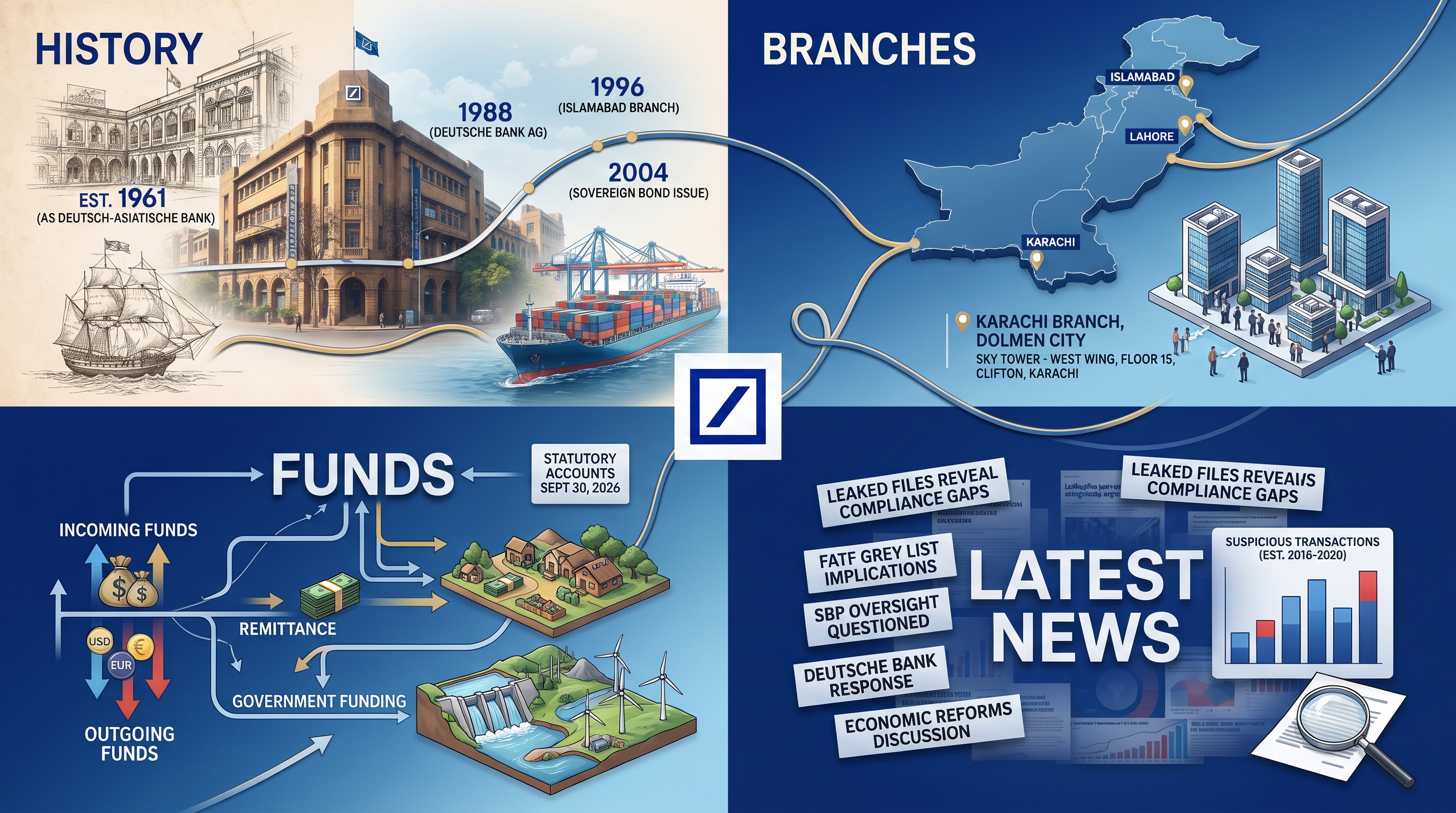
Deutsche Bank’s Pakistan Story. History, Branches, Funds and Latest News

Deutsche Bank has been operating in Pakistan for more than six decades. What began with a Karachi branch in 1962 evolved into a corporate and investment banking operation serving businesses, financial institutions, international investors, and trade-related clients.
But the bank’s Pakistan story has changed over the years. Its branch network has contracted, its business is focused primarily on institutional and corporate banking, and its role in international transactions has made it an important part of Pakistan’s financial infrastructure.
In November 2026, a new investigative report also raised questions about historical financial crime controls within Deutsche Bank’s Pakistan operations, bringing renewed attention to the bank’s compliance systems, regulatory responsibilities, and international banking relationships.
This article examines Deutsche Bank in Pakistan, including its history, branches, operations, accounts, deposits, financial results, State Bank of Pakistan regulation, international transactions, and the latest news. It separates verified information from allegations and explains what the available documents actually show.
Table of Contents
- Deutsche Bank. An overview
- History of Deutsche Bank in Pakistan
- Deutsche Bank branches in Pakistan
- Why did Deutsche Bank close its Islamabad branch?
- What services does Deutsche Bank Pakistan offer?
- Deutsche Bank accounts and banking facilities
- Deutsche Bank Pakistan funds and financial position
- Financial results for 2026
- Deutsche Bank and the State Bank of Pakistan
- Latest Deutsche Bank Pakistan news
- International investigations and compliance concerns
- Deutsche Bank’s role in Pakistan’s international trade
- Who can bank with Deutsche Bank Pakistan?
- How to contact Deutsche Bank Pakistan
- Frequently asked questions
- Final assessment
1. Deutsche Bank. An Overview
Deutsche Bank AG is a German multinational banking and financial services institution headquartered in Frankfurt, Germany. Its operations cover corporate banking, investment banking, financing, markets, asset management, private banking, and related financial services.
In Pakistan, Deutsche Bank operates as a foreign banking institution under the country’s banking regulatory framework.
Its Pakistan operation is substantially different from the retail banking model used by many local commercial banks. The bank primarily serves corporate clients, institutional customers, financial institutions, and businesses involved in international transactions.
According to its official Pakistan profile, Deutsche Bank offers corporate and investment banking products including foreign exchange, cash management, trade finance, treasury solutions, fixed income, corporate finance, and capital markets services.
The bank’s presence in Pakistan is particularly relevant to companies involved in imports, exports, foreign currency transactions, international investment, and cross-border financial activity.
Deutsche Bank Pakistan at a glance
| Detail | Information |
|---|---|
| Bank name | Deutsche Bank AG |
| Country of origin | Germany |
| Pakistan presence | Since 1962 |
| Current branch locations | Karachi and Lahore |
| Banking model | Corporate and institutional banking |
| Regulator | State Bank of Pakistan |
| Major services | Trade finance, cash management, FX, treasury, corporate finance |
| Current country leadership | Ali Haider Zaidi, appointed September 2025 |
| Official website | country.db.com/mea/company/country-profiles/pakistan |
Deutsche Bank is a foreign bank operating under Pakistan’s banking regulations. Its local operations are not the same as a typical nationwide retail bank with branches, ATMs, debit cards, personal loans, and consumer banking products for the general public.
2. History of Deutsche Bank in Pakistan
Deutsche Bank’s Pakistani history goes back to the early 1960s, when Germany and Pakistan were developing commercial and industrial relations.
1961. Permission to establish a branch
The bank’s Asian predecessor, Deutsch-Asiatische Bank, received permission from the State Bank of Pakistan in 1961 to establish a branch in Karachi.
The move was intended to support commercial relations between Germany and Pakistan, particularly trade, industrial investment, and German-Pakistani business partnerships.
January 24, 1962. Karachi branch opens
The Karachi branch officially opened on January 24, 1962.
The bank initially operated from the Ralli Building on McLeod Road, now known as I.I. Chundrigar Road. The location was significant because the area would later become one of Pakistan’s most important financial districts.
The branch supported German-Pakistani trade and provided banking facilities to industrial and business customers.
1972. European Asian Bank
Deutsch-Asiatische Bank became part of European Asian Bank, also known as EURASBANK, following its merger into the institution in 1972.
The Karachi operation subsequently became part of EURASBANK.
1977. Move to Unitower
The Karachi branch moved to Unitower on Chundrigar Road at the end of 1977, reflecting the development of Karachi’s financial and commercial infrastructure.
1983. Lahore branch opens
EURASBANK opened its Lahore branch in 1983, expanding the bank’s presence beyond Karachi.
Lahore was an important commercial centre with industrial businesses, exporters, importers, and corporate clients requiring international banking services.
1986. Deutsche Bank increases its ownership
Deutsche Bank increased its stake in EURASBANK from 60% to 75% in 1986.
The institution was renamed Deutsche Bank (Asia), which later merged with Deutsche Bank AG.
1988. Branches operate under Deutsche Bank AG
In 1988, the Karachi and Lahore branches began operating under the Deutsche Bank AG name after the merger of Deutsche Bank (Asia) into the parent bank.
This was an important transition in the bank’s Pakistani history, bringing its operations more directly into the Deutsche Bank global structure.
1996. Islamabad branch
Deutsche Bank opened a third branch in Pakistan in Islamabad in 1996.
This extended its physical presence into the country’s federal capital and government-related business environment.
However, the Islamabad branch is no longer listed among the bank’s current Pakistan branches.
The exact date and formal reason for the closure are not established by the primary records reviewed for this article.
2004. Pakistan sovereign bond issue
Deutsche Bank played a role in Pakistan’s return to international capital markets.
In 2004, it arranged Pakistan’s first sovereign bond issue since 1999, according to its historical account.
2005. International debt issuance
Deutsche Bank was also involved in a US$800 million sovereign bond offering for Pakistan in 2005.
The bank’s historical record describes the transaction as the largest-ever funding by the Republic of Pakistan at that time.
2011. Fifty years in Pakistan
Deutsche Bank marked 50 years of presence in Pakistan in 2011, counting its establishment in the country in 1961.
2021. Pakistan returns to international capital markets
In March 2021, Deutsche Bank led Pakistan’s return to international capital markets after an absence of almost four years.
It was also selected in June 2021 to lead Pakistan’s first green bond issuance for WAPDA, according to the bank’s published historical account.
2022. Diamond jubilee
The Karachi branch celebrated 60 years of business on January 24, 2022, marking the opening anniversary of its first Pakistani branch.
The bank said it employed close to 100 people across Karachi and Lahore at that time.
Deutsche Bank Pakistan timeline
| Year | Event |
|---|---|
| 1961 | Permission to establish Karachi branch |
| 1962 | Karachi branch officially opened |
| 1972 | Deutsch-Asiatische Bank integrated into EURASBANK |
| 1977 | Karachi branch moved to Unitower |
| 1983 | Lahore branch opened |
| 1986 | Deutsche Bank increased EURASBANK ownership |
| 1988 | Karachi and Lahore began operating as Deutsche Bank AG |
| 1996 | Third branch opened in Islamabad |
| 2004 | Arranged Pakistan sovereign bond issue |
| 2005 | Participated in US$800 million sovereign bond offering |
| 2011 | 50-year anniversary |
| 2021 | International capital market and green bond activity |
| 2022 | 60-year Karachi branch anniversary |
| 2025 | Ali Haider Zaidi appointed Country Chief |
| 2026 | Two branches remain listed, Karachi and Lahore |
3. Deutsche Bank Branches in Pakistan
As of the bank’s published 2026 financial statements, Deutsche Bank Pakistan operates two branches, one in Karachi and one in Lahore.
This is confirmed by its September 2026 interim financial statements, which state that the Pakistan operation is carried out through two branches located at Karachi and Lahore.
Karachi branch
The Karachi branch is located in Dolmen City, Clifton.
Address
Deutsche Bank AG Karachi Branch
Sky Tower, West Wing, 15th Floor
Dolmen City, Marine Drive, Clifton, Block 4
Karachi, Pakistan
Telephone. +92 21 111 555 777
Karachi serves as the bank’s main country location and is a major centre for corporate banking, financial markets, trade finance, and international business activity.
Lahore branch
Address
Deutsche Bank AG Lahore Branch
Askari Corporate Tower, 8th Floor, Office No. 3
75-76, D-1, Main Boulevard, Gulberg III
Lahore, Pakistan
Telephone. +92 42 111 555 777
The Lahore branch serves businesses and institutional customers in Punjab, including customers involved in manufacturing, export activity, industrial trade, and corporate finance.
Branch network comparison
| City | Historical status | Current status |
|---|---|---|
| Karachi | First branch, opened 1962 | Active |
| Lahore | Opened 1983 | Active |
| Islamabad | Opened 1996 | No longer listed as an operating branch |
The bank’s current branch network is significantly smaller than its historical network.
This does not mean Deutsche Bank has withdrawn from Pakistan. Its latest published statements confirm ongoing operations, financial activity, deposits, lending, and business in the country.
4. Why Did Deutsche Bank Close Its Islamabad Branch?
Deutsche Bank opened its Islamabad branch in 1996. The branch is no longer included in the current official branch list, which identifies only Karachi and Lahore.
However, the available official material reviewed does not provide a specific closure announcement, date, or confirmed explanation for the Islamabad closure.
It would therefore be inaccurate to state that the branch closed because of a particular political event, financial loss, security concern, regulatory decision, or management strategy without documentary evidence.
Possible reasons banks consolidate branches generally include:
- Changes in corporate customer demand.
- Cost and operational efficiency.
- Centralisation of services.
- Changes in the banking model.
- Strategic decisions about physical locations.
These are general banking factors, not confirmed reasons for Deutsche Bank’s Islamabad closure.
The important point is that the Islamabad branch’s disappearance from the current branch network does not establish that Deutsche Bank exited the country.
The bank continues to operate through its Karachi and Lahore branches.
5. What Services Does Deutsche Bank Pakistan Offer?
Deutsche Bank Pakistan focuses on corporate and institutional banking rather than mass-market personal banking.
Its services are designed for businesses, financial institutions, international investors, and organisations requiring sophisticated financial products.
Corporate banking
Corporate banking supports businesses with financial products required for daily operations and expansion.
Services may include corporate accounts, cash management, financing facilities, treasury services, trade finance, and business transaction support.
Trade finance
Trade finance is one of the bank’s important services in Pakistan.
Businesses importing or exporting goods may require:
- Letters of credit.
- Import financing.
- Export financing.
- Trade documentation.
- Guarantees.
- Structured trade finance.
- Foreign currency settlement.
- Transaction-related banking services.
These facilities help businesses manage payment risks, documentation requirements, and international trade obligations.
Foreign exchange
Companies involved in international trade often need to manage exposure to foreign currencies.
Deutsche Bank provides foreign exchange services and related financial market products for corporate and institutional clients.
These services may be relevant to importers, exporters, international companies, and businesses with foreign currency liabilities or receivables.
Cash management
Corporate cash management helps organisations manage collections, payments, liquidity, and account balances.
Companies with multiple suppliers, customers, or business locations may need structured cash management solutions to improve operational visibility.
Treasury solutions
Treasury services can help corporate clients manage liquidity, financial risks, interest rates, and foreign exchange exposure.
The availability and suitability of individual products depend on the customer, the bank’s approval process, regulatory requirements, and the commercial agreement.
Corporate finance and capital markets
Deutsche Bank Pakistan can access regional and global expertise for corporate finance solutions.
Its official Pakistan profile lists services including mergers and acquisitions advice, debt and equity capital markets, conventional and ESG-related capital market products, and structured trade finance.
These products are primarily relevant to larger companies, institutional clients, and organisations with substantial financial requirements.
6. Deutsche Bank Accounts and Banking Facilities
One of the most common questions about Deutsche Bank Pakistan is whether individuals can open a normal bank account.
The answer requires an important distinction.
Deutsche Bank Pakistan is primarily a corporate and institutional banking operation. Its official profile lists current, savings, and deposit accounts among corporate treasury solutions, but that does not mean it offers ordinary retail accounts to every individual.
Corporate current accounts
Businesses may require current accounts to manage operational payments, collections, trade transactions, and liquidity.
Account opening is subject to eligibility, documentation, due diligence, and the bank’s approval.
Savings and deposit accounts
The bank’s Pakistan profile mentions savings and deposit accounts as part of corporate banking facilities.
Availability, minimum balance requirements, interest or profit terms, currency, and other conditions depend on the specific product and customer eligibility.
Foreign currency accounts
Foreign currency banking can be relevant to businesses receiving international payments or managing foreign currency exposure.
The actual account options and permitted transactions are subject to applicable SBP regulations and the bank’s requirements.
Overdraft facilities
Overdraft facilities may be offered to eligible corporate clients, subject to credit approval and agreed terms.
These facilities can support short-term working capital requirements, but they involve borrowing costs and repayment obligations.
Trade-related accounts
Trade finance customers may require accounts and arrangements connected with import and export transactions.
These can involve documentation, foreign exchange processing, letters of credit, guarantees, and other banking services.
Does Deutsche Bank offer personal accounts in Pakistan?
It should not be assumed that Deutsche Bank Pakistan offers standard retail banking products such as personal debit cards, consumer loans, credit cards, mobile banking accounts, or everyday savings accounts to the general public.
Customers should contact the bank directly to confirm eligibility and the current availability of any specific account or facility.
7. Deutsche Bank Pakistan Funds and Financial Position
When discussing a bank’s funds, several different financial terms need to be separated.
Deposits are money held by the bank on behalf of customers and financial institutions.
Assets include cash, balances with other banks, lending, investments, and other financial resources.
Investments are financial instruments held by the bank.
Advances represent lending and credit facilities extended to customers.
These categories are not interchangeable. Deposits do not equal total assets, and a bank’s investments are not necessarily money available for immediate withdrawal by customers.
June 2026 financial position
Deutsche Bank AG Pakistan’s interim financial statements for June 30, 2026, report the following figures.
| Financial item | June 30, 2026 | PKR |
|---|---|---|
| Cash and balances with treasury banks | 13.065 billion | |
| Balances with other banks | 390.5 million | |
| Lendings to financial institutions | 47.664 billion | |
| Investments | 9.527 billion | |
| Advances | 7.886 billion | |
| Other assets | 4.062 billion | |
| Total assets | 83.737 billion | |
| Total deposits | 55.241 billion |
The figures are taken from the bank’s published interim financial statements. Amounts are rounded for readability.
Total assets chart
June 30, 2026. PKR billions.
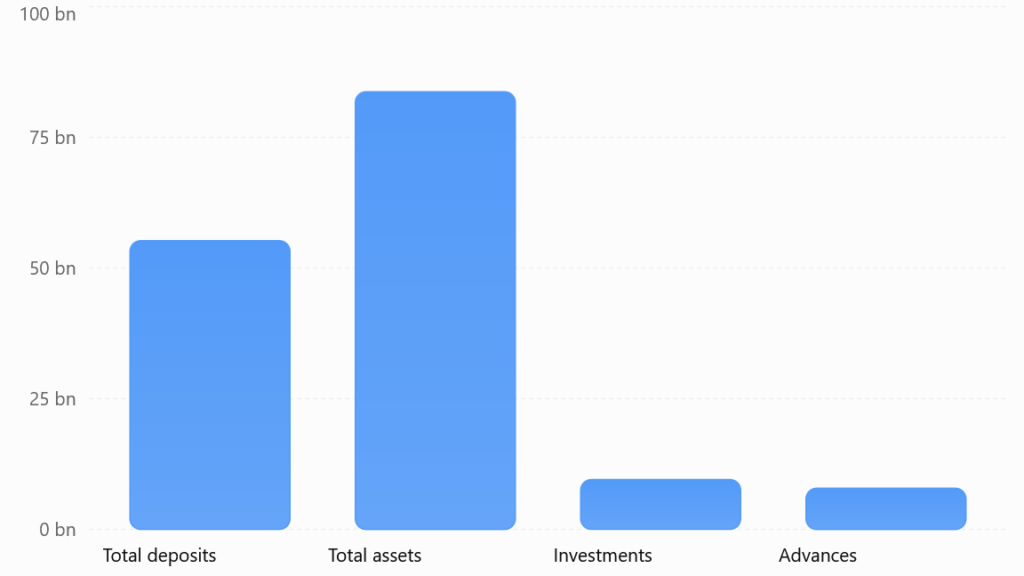
The largest category shown in the bank’s financial position is lendings to financial institutions, followed by cash and treasury balances, investments, and advances.
This asset structure is consistent with a bank that operates within the corporate and financial institution banking environment rather than a mass retail lending model.
Deposits
The bank reported total deposits of approximately PKR 55.24 billion at June 30, 2026.
Deposits are important to understanding the bank’s local funding position. They include customer deposits and other deposit categories recorded in the published statements.
The figure should not be interpreted as the amount of funds held for one individual customer, nor as a measure of the bank’s total international assets.
8. Deutsche Bank Pakistan Financial Results for 2026
The bank’s six-month interim financial statements for the period ended June 30, 2026, provide information about its performance.
Profit before tax
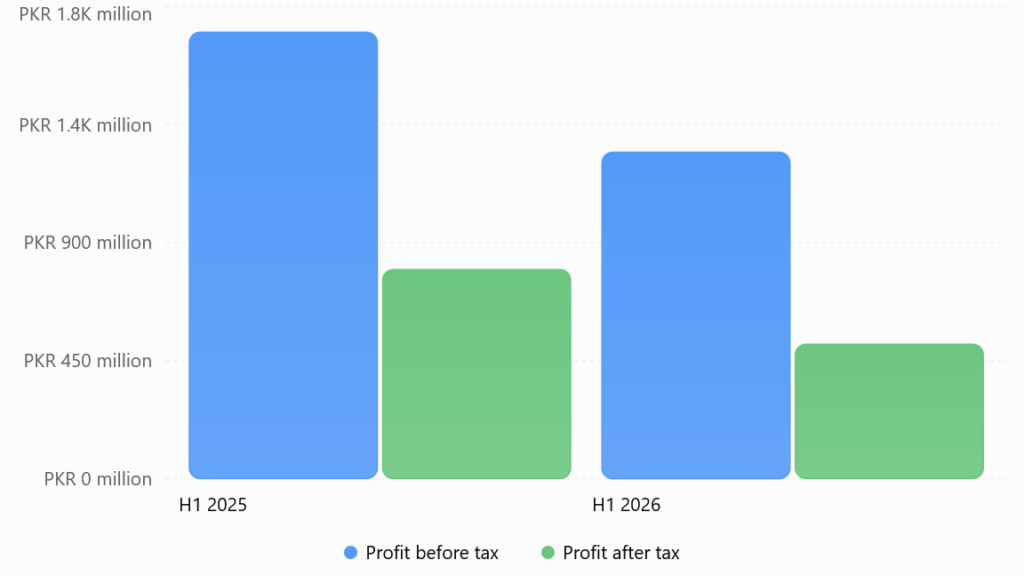
For the six months ended June 30, 2026, Deutsche Bank Pakistan reported profit before taxation of approximately PKR 1.245 billion.
Profit after tax
Profit after taxation was approximately PKR 512.4 million.
Comparison with the first half of 2025
| Financial measure | H1 2025 | H1 2026 |
|---|---|---|
| Profit before tax | PKR 1.702 billion | PKR 1.245 billion |
| Profit after tax | PKR 797.4 million | PKR 512.4 million |
The figures indicate lower profit compared with the corresponding period of 2025.
Profit after tax declined by approximately 35.8% year-on-year, while profit before tax declined by approximately 26.8%.
These figures describe the Pakistan operation’s reported results for the relevant periods. They do not, by themselves, explain the reasons for the decline.
A full assessment would require examining income composition, expenses, funding costs, foreign exchange effects, provisions, tax, and broader economic conditions.
Financial comparison chart
Is Deutsche Bank Pakistan financially active?
Yes. Its published financial statements show ongoing banking operations, deposits, assets, financial institution lending, investments, advances, income, expenses, and profits.
The bank’s statements also indicate that its Pakistan operation is prepared on a going-concern basis.
That means the financial statements are prepared on the assumption that the operation will continue its business rather than being liquidated or discontinued. It is not a guarantee of future performance.
9. Deutsche Bank and the State Bank of Pakistan
The State Bank of Pakistan is the country’s central bank and banking regulator.
Foreign banks operating in Pakistan are subject to relevant banking laws, regulatory requirements, supervisory frameworks, and reporting obligations.
Deutsche Bank Pakistan’s published financial statements explicitly state that they are prepared in accordance with applicable accounting and reporting standards in Pakistan and SBP directives.
Banking regulation
The bank’s Pakistan operations are governed by the regulatory framework applicable to banking companies, including relevant provisions of the Banking Companies Ordinance, 1962, and applicable SBP regulations.
Regulatory responsibilities include areas such as:
- Banking supervision.
- Capital and liquidity requirements.
- Financial reporting.
- Customer due diligence.
- Anti-money laundering controls.
- Combating financing of terrorism.
- Foreign exchange regulation.
- Trade finance monitoring.
- Consumer protection and complaint handling where applicable.
Foreign exchange regulation
Deutsche Bank Pakistan is listed by the SBP as an authorised foreign exchange dealer.
Foreign exchange activity is subject to applicable SBP rules, reporting requirements, and transaction controls.
Electronic Credit Information Bureau
Deutsche Bank Pakistan states that it regularly compiles customer data for reporting to SBP’s Electronic Credit Information Bureau, or eCIB, in accordance with applicable requirements.
The eCIB system helps financial institutions assess borrowers’ credit histories and manage lending risks.
Regulatory oversight does not mean every issue is automatically resolved
A bank’s regulatory licence and published financial statements do not prove that every transaction, control, or compliance process has always been flawless.
Likewise, an investigative report identifying historical compliance concerns does not automatically establish that the regulator has found the bank guilty of every allegation described.
Regulatory findings, audit observations, internal correspondence, and proven legal violations are different categories of evidence.
10. Latest Deutsche Bank Pakistan News. November 2026
On November 25, 2026, Dawn published an investigative report titled:
“What happens when a bank ducks rules in Pakistan? For Deutsche Bank, perhaps nothing.”
The report examined leaked internal bank records and raised concerns about historical financial crime controls within Deutsche Bank’s Pakistan operations.
It was part of an international investigation involving leaked Deutsche Bank documents and journalists across multiple countries.
What the investigation reported
According to Dawn’s reporting, internal records and audit documents raised questions about areas including:
- Trade-based money laundering controls.
- Price due diligence mechanisms.
- Monitoring of suspicious transactions.
- Sanctions screening.
- Customer identification and KYC.
- Certain custody-related accounts.
- Compliance responsibilities and internal decision-making.
The article reported that an internal audit email in July 2021 raised concerns about implementation of aspects of SBP’s trade-based money laundering framework.
It also described historical internal discussions concerning customer identification and the treatment of sub-accounts linked to custodial arrangements.
What the report does not establish
The article explicitly stated that the documents reviewed do not necessarily establish that suspicious or illicit transactions passed through the bank.
It also reported that the documents did not clearly establish whether the identified compliance issues had ultimately been resolved or what corrective actions were implemented.
This distinction matters.
An audit observation can identify a weakness or control failure. A leaked email can document an internal concern. Neither automatically proves criminal conduct or that a particular customer committed wrongdoing.
Deutsche Bank’s response
According to Dawn, Deutsche Bank declined to comment on potential, former, or existing client relationships and stated that it takes its obligations to prevent financial crime seriously and maintains controls designed to comply with applicable anti-money laundering, sanctions, and other regulatory requirements.
The report also said the SBP did not respond to Dawn’s detailed questionnaire before publication.
The allegations should therefore be treated as reported investigative findings and historical compliance concerns, not as a final court judgment or confirmed regulatory finding against the bank on every matter described.
11. International Investigations and Deutsche Bank’s Compliance History
Deutsche Bank is a major international financial institution and has faced regulatory scrutiny and settlements in different jurisdictions over various matters throughout its history.
These cases have involved issues such as sanctions compliance, financial crime controls, market conduct, and regulatory requirements.
The international context matters because large banks operate across countries with different legal systems, sanctions regimes, financial crime risks, and supervisory expectations.
However, an international enforcement case involving Deutsche Bank should not automatically be attributed to its Pakistan operation.
Each case needs to be assessed according to:
- The country where the issue occurred.
- The legal entity involved.
- The regulator or authority responsible.
- The specific conduct alleged or established.
- The date of the event.
- The settlement, court judgment, or regulatory outcome.
The November 2026 Dawn investigation specifically examined Pakistan-related internal records. Its claims should be assessed on the evidence described in that investigation and the bank’s response.
It would be misleading to combine unrelated international cases into a single claim that Deutsche Bank Pakistan was involved in every global compliance issue.
12. Deutsche Bank’s Role in Pakistan’s International Trade
Deutsche Bank’s Pakistan operation has historically played a role in international trade, cross-border payments, and corporate financial transactions.
Pakistan’s importers, exporters, multinational companies, and financial institutions require banking infrastructure for payments, settlements, financing, foreign exchange, and trade documentation.
Deutsche Bank’s global network can support transactions involving international counterparties and foreign markets.
Trade finance
Trade finance is a significant part of international banking.
A business exporting goods may require a letter of credit, payment collection, financing, or other documentation to complete a transaction.
An importer may need financing or settlement arrangements to pay an overseas supplier.
Banks provide services to help manage these transactions, subject to customer due diligence, sanctions screening, documentation, and regulatory requirements.
Cross-border payments
Cross-border payments can involve multiple financial institutions, currencies, correspondent banking relationships, and payment instructions.
In 2016, Dawn’s November 2026 investigative article reported figures from internal documents concerning Pakistan-related transactions through Deutsche Bank’s global network.
Those figures related to historical transaction activity and should not be treated as current 2026 volumes.
Pakistan’s sovereign financing
Deutsche Bank has also participated in Pakistan’s international capital market transactions.
Its historical record identifies roles in sovereign bond offerings and Pakistan’s return to international capital markets in 2021.
These transactions demonstrate the bank’s institutional role in international financing, but they do not establish that every government or corporate transaction is currently handled by Deutsche Bank.
13. Who Can Bank With Deutsche Bank Pakistan?
The bank’s focus is corporate and institutional banking.
Potential customer categories may include:
- Large businesses.
- Multinational companies.
- Exporters and importers.
- Corporate treasury departments.
- Financial institutions.
- Institutional investors.
- Businesses with international payment requirements.
- Organisations requiring trade finance.
- Companies seeking capital markets or corporate finance services.
Individuals looking for ordinary personal banking services should confirm directly with the bank whether their requirements fall within its current product offering.
A customer should not assume that a foreign bank’s presence in Pakistan means it offers the same retail products as local commercial banks.
14. How to Contact Deutsche Bank Pakistan
Customers and companies can contact the bank through its official Pakistan channels.
Karachi
Deutsche Bank AG Karachi Branch
Sky Tower, West Wing, 15th Floor
Dolmen City, Marine Drive, Clifton, Block 4
Karachi, Pakistan
Telephone. +92 21 111 555 777
Lahore
Deutsche Bank AG Lahore Branch
Askari Corporate Tower, 8th Floor, Office No. 3
75-76, D-1 Main Boulevard, Gulberg III
Lahore, Pakistan
Telephone. +92 42 111 555 777
Official website
For account enquiries, trade finance, foreign exchange, corporate banking, complaints, and product eligibility, use the bank’s official contact details and confirm current information before visiting.
15. Frequently Asked Questions
Is Deutsche Bank still operating in Pakistan in 2026?
Yes. Deutsche Bank’s 2026 financial statements show that it continues to operate through two branches in Pakistan, located in Karachi and Lahore.
When did Deutsche Bank start in Pakistan?
The bank’s predecessor, Deutsch-Asiatische Bank, opened its first Pakistani branch in Karachi on January 24, 1962. The bank’s historical establishment dates to 1961, when permission was received to establish the branch.
How many Deutsche Bank branches are there in Pakistan?
Its published 2026 statements confirm two branches, in Karachi and Lahore.
Did Deutsche Bank close its Islamabad branch?
The Islamabad branch was opened in 1996 and is no longer listed in the current branch network. The exact closure date and confirmed reason for closure have not been established by the primary records reviewed.
Does Deutsche Bank Pakistan offer personal accounts?
The bank primarily serves corporate and institutional customers. Its official profile lists current, savings, and deposit accounts in the corporate banking context. Ordinary personal banking availability should be confirmed directly with the bank.
What is Deutsche Bank Pakistan’s total deposit amount?
The bank reported approximately PKR 55.24 billion in total deposits as of June 30, 2026, according to its published interim financial statements.
What were Deutsche Bank Pakistan’s profits in 2026?
For the six months ended June 30, 2026, it reported approximately PKR 1.245 billion in profit before tax and PKR 512.4 million in profit after tax.
Is Deutsche Bank regulated by SBP?
Yes. Deutsche Bank AG’s Pakistan operations are subject to the applicable banking regulatory framework and supervision of the State Bank of Pakistan.
What happened in the November 2026 Deutsche Bank investigation?
Dawn published an investigative report on November 25, 2026, based on leaked internal documents. It raised questions about historical financial crime controls and compliance processes. The report did not establish that all suspicious activity allegations were proven, and the bank stated that it maintains controls designed to comply with applicable financial crime requirements.
Does Deutsche Bank Pakistan handle international payments?
It offers corporate banking services including foreign exchange, cash management, trade finance, and treasury solutions. Specific payment arrangements depend on the customer’s requirements and applicable regulations.
Can small businesses open an account at Deutsche Bank?
Eligibility depends on the bank’s customer criteria, business profile, transaction requirements, and documentation. Small businesses should contact the bank to confirm whether its services fit their needs.
16. Final Assessment. Deutsche Bank’s Pakistan Story
Deutsche Bank’s history in Pakistan stretches from 1962 to the present. Its operations have changed through mergers, branch expansion, restructuring, and a shift toward a more concentrated corporate and institutional banking model.
The Karachi branch remains the historic centre of its Pakistan business. Lahore continues to serve as its second listed branch. Islamabad, which was added in 1996, is no longer part of the current branch network.
Its published 2026 financial statements show that the bank remains financially active in Pakistan, with deposits, assets, investments, lending, and reported profits. The bank continues to participate in corporate banking, trade finance, foreign exchange, treasury, and institutional financial services.
The latest November 2026 investigative report introduces a separate and serious question about historical compliance systems. The allegations and audit concerns deserve scrutiny, but they should be reported accurately. Internal findings, unresolved questions, regulatory conclusions, and criminal wrongdoing are not the same thing.
For businesses, financial institutions, researchers, and customers, the most reliable way to understand Deutsche Bank Pakistan is to examine its official statements, SBP records, verified news reports, and relevant regulatory documents together.
QW HOSTING will continue covering banking, business, technology, financial markets, and international developments relevant to Pakistan through research-based articles and factual reporting.


