
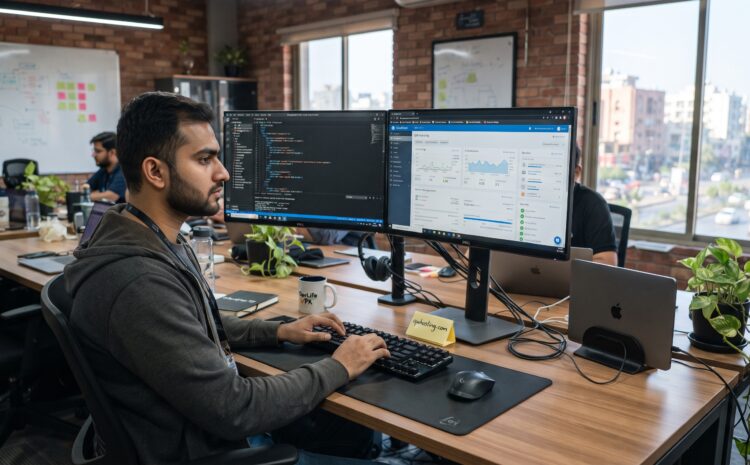
Web Development Company in Pakistan: A Business Guide for 2026

Choosing the right web development company is an important decision for any business that wants to build a professional online presence, reach more customers, or improve its digital operations. A website can introduce your services, generate enquiries, sell products, support customers, and connect different parts of your business. But achieving these goals requires more than an attractive homepage.
Businesses in Pakistan have different requirements. A small consultancy may need a straightforward company website, while a retailer may need an e-commerce store, an established company may require a customer portal, and a startup may need a custom web application.
The right development partner should understand your business objectives, recommend suitable technology, explain the project scope, and deliver a website that your team can maintain after launch.
QW HOSTING helps businesses explore website development and digital solutions for their online presence. This guide explains what a web development company does, which services to compare, how to evaluate WordPress and custom development, what affects project costs in Pakistan, and how to choose a provider for your next project.
What Is a Web Development Company?
A web development company plans, builds, tests, launches, or maintains websites and web applications. Depending on its capabilities, it may also provide website design, content management systems, e-commerce development, integrations, performance improvements, and technical support.
Web development involves both the visible experience of a website and the underlying systems that make it work.
For example, a business website might display services, testimonials, and contact details. Behind the scenes, it may use a content management system, database, contact form, analytics tools, and email notifications.
A more complex web application could include customer accounts, staff dashboards, payment processing, reporting, and connections to third-party services.
A professional development project typically considers:
- Business objectives and target customers.
- Website structure and user experience.
- Visual design and responsive layouts.
- Front-end development and, where needed, back-end programming.
- Content management and editing permissions.
- Search engine optimisation foundations.
- Security, performance, and accessibility.
- Testing, launch, maintenance, and future improvements.
The precise scope depends on the project. Not every business needs custom software, and not every website should be built from a pre-designed template.
The objective is to choose an approach that solves the business problem without adding unnecessary complexity or cost.
Why Do Businesses in Pakistan Need Professional Web Development?
A business website can provide a central place where potential customers learn about a company, compare its services, review relevant evidence, and contact the team.
Social media profiles and messaging apps can be valuable communication channels, but a dedicated website offers more control over the structure, content, navigation, and customer journey.
Establish a credible digital presence
Customers often want to understand a business before making contact. A well-organised website can explain what the company does, who it serves, how its process works, and how to request further information.
This is particularly useful for professional services, software companies, consultancies, manufacturers, retailers, and businesses selling to other businesses.
Credibility should come from accurate information, genuine project examples, clear contact details, and transparent service descriptions. A website should not use invented testimonials, fake customer logos, or unsupported claims to create an impression of experience.
Generate qualified business enquiries
A website can help attract enquiries from customers who are already looking for a particular service.
For example, a software development company can publish detailed pages about web applications, e-commerce platforms, integrations, and ongoing maintenance. Each page can explain the relevant service and offer a suitable next step.
A clear enquiry form can ask visitors about their business, requirements, estimated budget, and preferred timeline. The form should request only information that helps the company assess and respond to the enquiry.
Support sales beyond business hours
A website can provide service descriptions, pricing information where appropriate, frequently asked questions, downloadable documents, and enquiry forms at any time.
It does not replace a sales team, but it can reduce repetitive explanations and help potential customers prepare for a conversation.
Create a foundation for long-term growth
A well-planned website can expand as a business grows. A company may start with a homepage, services, about page, and contact page, then add a portfolio, blog, booking functionality, customer portal, or online store.
The original architecture should make these changes manageable rather than forcing the business to rebuild everything.
What Services Does a Web Development Company Offer?
Development companies vary in specialisation. Some focus on WordPress and business websites, while others build complex applications or e-commerce systems. Before requesting a quotation, understand which services your project actually requires.
1. Business website development
A business website introduces a company and its services through a structured set of pages. It may include a homepage, service pages, company information, portfolio, contact details, and lead-generation forms.
This is often appropriate for small and medium-sized businesses, consultants, agencies, and professional service providers.
The main priorities are clear communication, usable navigation, mobile compatibility, and straightforward content management.
2. WordPress website development
WordPress is a content management system that allows authorised users to manage pages, blog posts, images, and other website content through an administration interface.
It is a practical option for many business websites because it supports a broad ecosystem of themes and plugins. A company can start with a relatively simple website and extend it as its needs change.
A WordPress project may include theme configuration, custom templates, Elementor-compatible layouts, forms, analytics integration, migration, and technical SEO setup.
However, WordPress is not automatically the best choice for every project. Plugin compatibility, maintenance, security, hosting, and the complexity of the required features should all be considered.
Visit WordPress.org to explore the platform and its official resources.
3. E-commerce website development
An e-commerce website enables a business to display products, manage orders, and accept payments through supported payment integrations.
Depending on the requirements, an online store may need:
- Product categories and search.
- Product pages, images, and variations.
- Shopping cart and checkout.
- Shipping rules and delivery information.
- Payment gateway integration.
- Inventory and order management.
- Customer notifications and order tracking.
- Sales reporting and analytics.
Businesses in Pakistan should confirm that the chosen payment gateway, bank, or payment service supports their business model and settlement requirements.
The development company should also explain how order data, customer information, backups, and store updates will be managed.
4. Custom web application development
A web application provides functionality beyond a conventional content-based website. Examples include customer portals, internal dashboards, booking systems, reporting tools, and workflow applications.
Custom development may involve user authentication, role-based access, databases, APIs, automated notifications, and connections to other business systems.
Before building a custom application, document the actual workflow. Identify the users, their permissions, the information they need, and the tasks they must complete.
This reduces the risk of paying for features that do not solve a real business problem.
5. Website redesign and modernisation
An existing website may need a redesign if its layout is difficult to use, content is outdated, pages do not work well on mobile, or the business has changed its services.
A redesign should begin with an audit rather than an assumption that everything must be replaced.
Review the existing URLs, search traffic, important landing pages, forms, integrations, and customer journeys. If URLs change, implement appropriate redirects and verify the new pages after launch.
6. Website maintenance and technical support
Websites need ongoing care. WordPress core software, themes, plugins, server software, and integrations may require updates. Forms and payment workflows also need testing.
A maintenance agreement should specify the tasks included, backup frequency, update procedures, support hours, response expectations, and additional charges.
Do not assume that a website is fully maintained simply because it remains online.
WordPress or Custom Development: Which Is Better?
The best platform depends on what the website must do, who will maintain it, and how the business expects to grow.
| Requirement | WordPress | Custom development |
|---|---|---|
| Standard business website | Often a practical fit | May be unnecessary |
| Blog and content publishing | Strong content management capabilities | Requires an appropriate content system |
| Simple service pages | Often cost-effective to maintain | Useful only when special requirements justify it |
| E-commerce | Possible with suitable extensions | Can support specialised commerce workflows |
| Complex business processes | Depends on integrations and architecture | May provide greater flexibility |
| Visual editing | Available through supported themes and builders | Depends on the chosen implementation |
| Ongoing maintenance | Requires software and plugin management | Depends on the custom technology stack |
| Specialised integrations | Possible when compatible solutions exist | Can be designed around specific requirements |
These are general comparisons, not guarantees of cost or performance. A poorly configured WordPress website can be expensive to maintain, while a carefully scoped custom application can be an excellent investment for a specific workflow.
For many Pakistani small businesses, WordPress is worth evaluating first when the requirements are primarily informational and content-driven. For a unique application with complex business rules, custom development may be more appropriate.
How Much Does Website Development Cost in Pakistan in 2026?
There is no single price for a website. Costs depend on the scope, design requirements, technology, content, integrations, testing, and ongoing support.
A five-page company website is fundamentally different from an e-commerce store with inventory management or a custom application with user accounts.
Main factors affecting development costs
Project scope: More unique page layouts, complex workflows, and specialised features generally require additional work.
Design requirements: A customised visual identity and detailed interface design may require more time than adapting a suitable existing theme.
Content preparation: Copywriting, photography, translation, product data, and content migration may be separate deliverables.
Integrations: Payment gateways, customer relationship management systems, booking tools, accounting software, and external APIs can add development and testing requirements.
Technical complexity: Authentication, permissions, reporting, custom databases, and automated processes require careful planning and implementation.
Maintenance: Hosting, backups, security monitoring, updates, and support may create ongoing costs after launch.
A practical project budgeting chart
The following is a scope-based planning guide, not a verified survey of current Pakistani market prices. Obtain current quotations before setting a budget.
| Project type | Typical scope | Main cost drivers |
|---|---|---|
| Basic business website | Core company pages and contact form | Page count, content, responsive design |
| Professional service website | Detailed services, portfolio, lead generation | Custom layouts, copywriting, integrations |
| E-commerce website | Products, checkout, orders | Catalogue size, payment and delivery setup |
| Custom web application | Accounts, workflows, database, dashboards | Architecture, security, integrations, testing |
| Ongoing maintenance | Updates, backups, troubleshooting | Support level, workload, response requirements |
A simple relative-complexity chart can help with early planning:
- Basic business website: ■■
- Professional service website: ■■■
- E-commerce website: ■■■■
- Custom web application: ■■■■■
- Ongoing maintenance: depends on the support agreement
Chart note: These symbols represent illustrative project complexity, not actual prices, development hours, or measured industry averages. A simple online store may be less complex than a large service website, depending on the requirements.
How to compare quotations properly
Ask each company to specify the deliverables rather than relying on a single headline price.
A written proposal should clarify:
- The number of pages and unique layouts.
- Whether design and content creation are included.
- The platform and any premium themes or plugins required.
- The functionality included in the agreed scope.
- The client’s responsibilities for content and approvals.
- The testing and launch process.
- Domain, hosting, and third-party subscription costs.
- The revision process and limits.
- The warranty or post-launch support period.
- The ownership and handover arrangements.
A cheaper quotation may omit essential services. A more expensive quotation is not automatically better. Compare the scope, technical approach, deliverables, and support arrangements before deciding.
Regional Planning: Building Websites for Pakistan’s Market
A website for Pakistani customers should reflect the business’s actual audience, communication needs, payment arrangements, and operating model.
A company serving customers nationally may have different requirements from a local service provider or an exporter targeting international buyers.
The following regional planning chart provides a practical starting point.
| Consideration | What to plan for |
|---|---|
| Audience | Define the customers, cities, industries, or regions the business serves |
| Language | Choose English, Urdu, or other languages according to real customer needs |
| Mobile experience | Test navigation, forms, images, and page layouts on mobile devices |
| Payments | Verify supported gateways, settlement options, and transaction requirements |
| Communication | Offer contact methods the team can reliably monitor |
| Connectivity | Test website performance across relevant networks and locations |
| Search visibility | Create useful service pages and accurate business information |
| Trust | Publish genuine company details, work examples, and verifiable claims |
This is a planning framework rather than a statistical study. It does not claim that every Pakistani customer prefers the same language, device, or payment method.
Use credible regional data
When publishing statistics about Pakistan’s internet use, broadband adoption, mobile connectivity, or digital commerce, use dated sources and explain what the figures measure.
Useful research starting points include the Pakistan Telecommunication Authority for telecommunications information and the Pakistan Bureau of Statistics for official statistical publications.
Do not combine figures from different reporting periods or present a national statistic as though it describes every city or customer group. If QW HOSTING collects genuine project analytics or customer research, that evidence can add useful first-hand insight when its methodology and limitations are explained.
What Makes a Website Fast, Secure, and Reliable?
Website quality is not determined by design alone. Technical decisions affect how visitors experience the site and how easily the business can maintain it.
Responsive design
Layouts should adapt to different screen sizes. Menus, forms, tables, and calls to action should remain usable on mobile devices.
Test important customer journeys, not just the homepage. A contact form that looks correct but cannot be completed on a phone can prevent a potential customer from contacting the business.
Performance optimisation
Page speed can be affected by image sizes, scripts, plugins, caching, server configuration, database queries, and third-party services.
A development company should identify actual performance bottlenecks instead of promising that a particular hosting plan or plugin will solve every issue.
Use Google PageSpeed Insights to investigate performance and follow up with testing on important pages.
Security and data protection
Security should be considered during development rather than added only after launch.
A website may need HTTPS, access controls, secure configuration, software updates, backups, spam protection, and appropriate handling of customer data.
For websites that collect personal information or process payments, clarify which systems store the data, who can access it, and how it is protected. Legal and regulatory requirements depend on the business and its activities, so obtain specialist advice when necessary.
Accessibility and usability
Visitors should be able to read content, navigate the website, understand form labels, and use essential controls. Consider text contrast, keyboard navigation, meaningful alternative text, and clear error messages.
Accessibility improvements can make a website easier to use for a wider range of visitors.
SEO, AEO, GEO, and AI Search: What Should Your Developer Know?
Search engine optimisation should be considered during website planning. A site that is difficult to crawl, poorly structured, or missing important content can create avoidable obstacles for search visibility.
A professional development project should consider:
- Clear page titles and headings.
- Descriptive URLs.
- Crawlable internal links.
- Appropriate indexation settings.
- XML sitemap configuration where useful.
- Canonical URLs for relevant duplicate-page scenarios.
- Mobile usability and performance.
- Structured data that accurately reflects visible content.
- Useful page content written for the intended audience.
- Analytics and search performance monitoring.
Does AI search require a separate optimisation system?
Google’s published guidance says the same foundational SEO practices apply to AI Overviews and AI Mode. There is no separate special markup that guarantees inclusion in these experiences.
For a web development company, this means building pages that can be crawled and indexed, ensuring key information is available as text, linking related pages clearly, and publishing content that provides real value.
Answer Engine Optimisation (AEO) and Generative Engine Optimisation (GEO) can be useful ways to describe the goal of making content clear and discoverable. They should not be treated as shortcuts that replace sound technical SEO and useful content.
Official guidance:
- Google Search Essentials
- Google’s guidance on AI features and websites
- Google’s guidance on generative AI content
Google also cautions against producing large volumes of pages with little added value. A smaller set of accurate, useful service pages is generally a better starting point than publishing many near-identical pages solely to target keyword variations.
How to Choose the Right Web Development Company
Selecting a development partner involves more than reviewing a portfolio. You should understand how the company manages requirements, technical decisions, communication, delivery, and future support.
Review relevant work
Look for examples that resemble your project in complexity and purpose. A business website portfolio may not demonstrate the ability to build a complex booking application.
Ask what work the company actually completed and whether it is authorised to share the examples. Where performance results are presented, ask how they were measured.
Evaluate the discovery process
A reliable provider should ask questions about your business, users, required functionality, budget, and expected outcomes before recommending a solution.
If a company proposes a complex custom application before understanding your workflow, request an explanation of why simpler options would not meet the requirements.
Confirm ownership and access
Clarify who will own the domain, hosting account, website files, content, and any custom code after delivery.
If premium plugins, themes, or third-party services are required, confirm the licence owner, renewal costs, and transfer arrangements.
Understand communication and support
Agree on the project contact, approval process, milestones, revision limits, and method for reporting issues.
Ask what happens when a bug is discovered after launch, whether maintenance is included, and how additional requests are priced.
Avoid unsupported promises
No development company can responsibly guarantee a specific Google ranking simply by building a website. Likewise, promises of a fixed number of leads or sales should be supported by a clearly defined and credible basis.
Choose a provider that explains what it can control and how the result will be evaluated.
A Step-by-Step Website Development Process
A structured process makes it easier to manage the project and identify problems before launch.
Step 1: Define the business goal
Decide whether the website should generate leads, sell products, support customers, publish information, or automate a workflow.
Choose a primary objective and identify how success will be measured.
Step 2: Document the requirements
Prepare a list of pages, user roles, integrations, content needs, and essential features. Separate must-have functionality from optional improvements.
This helps the developer estimate the project more accurately.
Step 3: Plan the structure and design
Create a sitemap and establish the navigation. Develop page layouts that prioritise the information customers need and the actions the business wants them to take.
Obtain approval before implementing large amounts of content or functionality.
Step 4: Develop and integrate
Build the website using the agreed platform and technology. Configure forms, integrations, security settings, and content management features as specified in the proposal.
Keep the implementation aligned with the documented requirements.
Step 5: Test the website
Test important pages, mobile layouts, links, forms, login flows, payment processes where applicable, and notification delivery.
Review security settings, backups, redirects, and analytics configuration before launch.
Step 6: Launch and hand over
Confirm the production domain, HTTPS, indexation settings, administrator access, and recovery procedures.
Provide documentation or training so the business can manage routine content updates.
Step 7: Monitor and improve
After launch, monitor enquiries, user behaviour, search visibility, and technical errors. Prioritise improvements based on actual evidence and business needs.
A website should be treated as an evolving business tool rather than a project that never needs attention after launch.
Frequently Asked Questions
What does a web development company do?
A web development company builds and maintains websites or web applications. Services can include design, front-end and back-end development, WordPress, e-commerce, integrations, testing, SEO foundations, and ongoing support.
Which web development company is best in Pakistan?
The right company depends on your project, budget, platform, industry, and support requirements. Compare relevant work, technical capability, proposals, ownership terms, communication, and maintenance arrangements instead of relying on an unsupported ranking.
How much does web development cost in Pakistan?
The price depends on project scope, page count, design complexity, content, integrations, and ongoing support. Request a written quotation that identifies deliverables, exclusions, third-party costs, and post-launch responsibilities.
Is WordPress suitable for a small business?
WordPress can be a practical option for many small businesses that need service pages, company information, a blog, or a content-managed website. Its suitability depends on the required functionality, maintenance capacity, hosting, and security arrangements.
How long does it take to develop a website?
The timeline depends on the number of unique layouts, availability of content, integrations, revision cycles, testing, and client approvals. Establish milestones and responsibilities with the development company before work begins.
Does web development include SEO?
Not necessarily. Some providers include technical SEO foundations, while others quote SEO as a separate service. Confirm whether page titles, indexation settings, redirects, sitemaps, analytics, and content optimisation are included.
Can a website be redesigned without losing SEO progress?
A redesign can preserve important SEO elements if the project is planned carefully. Review existing URLs and content, maintain valuable pages where possible, implement appropriate redirects when URLs change, and monitor indexing and performance after launch.
Who should own the website after development?
The business should understand and retain appropriate control of its domain, hosting, content, administrator access, and relevant licences or source code as agreed in the contract. Ownership arrangements should be documented before the project begins.
Build Your Next Website with QW HOSTING
Choosing a web development company is an investment in how your business communicates, operates, and serves customers online. The right solution should match your goals, fit your budget, and remain manageable after launch.
For many businesses, a well-built WordPress website offers a practical starting point. Companies with specialised workflows may need custom development, while online retailers require careful planning for product management, checkout, payments, and order handling.
Before selecting a provider, compare the scope of work, technology, support, security, ownership terms, and realistic delivery expectations. Ask for a clear proposal and ensure that the finished website will support the way your business actually operates.
QW HOSTING offers a starting point for businesses exploring web development and digital services. Visit qwhosting.com to learn more and discuss your website requirements.
The goal is not simply to launch a website. It is to create a useful, reliable digital platform that helps customers understand your business and makes it easier for them to take the next step.